San Domenico, San Vito, and Two Allegorical Figures: The Baroque Portal That Introduces Masseria Palesi
Four stone statues stand above the entrance. San Domenico in his habit. San Vito with his dog. Two allegorical female figures, one on each side, framed by the sentry boxes that flank the gate. Below them, the wooden portal — richly carved in exposed stone, designed by local craftsmen working in the tradition of the Lecce Baroque — that opens onto the courtyard of a seventeenth-century fortified complex near Martina Franca in the province of Taranto. Masseria Palesi does not announce itself quietly. The entrance alone is a statement about what this place is and where it comes from: a noble family's estate in the Valle d'Itria, built and decorated at a moment when the stone carvers of Martina Franca were producing work that rivalled the great workshops of Lecce, and that carries in every carved surface the ambition and the aesthetic confidence of that tradition. For international couples planning a destination wedding in Puglia who want a venue that reads as art history as well as agricultural heritage, this estate near Martina Franca is one of the most richly specific places available anywhere in this region.
I work regularly in the Martina Franca area as a wedding photographer in the province of Taranto, and Masseria Palesi occupies a position in this territory that is unlike any other estate I know. The oak forest that surrounds it — centuries-old oaks and holm oaks, the tree of the Murge plateau rather than the olive of the coast — gives this place a different register from almost every other masseria I photograph. It is darker, more enclosed, more genuinely wild. The light it produces at golden hour is not the open horizontal light of an olive grove but something filtered, dappled, more northern in quality — and for a wedding that wants to feel genuinely rooted in a specific, unusual landscape, that difference matters enormously.
The Baroque Palazzo and Its Frescoed Salons
The palazzo at Masseria Palesi is the physical expression of what it meant to be a noble family in seventeenth- and eighteenth-century Puglia — at least in this corner of it, where the Baroque vocabulary arrived from the nearby workshops of Lecce and found in the local white stone a material perfectly suited to its ambitions. Easily carved when freshly quarried, hardening over time to an amber that registers every shadow with precision: this is the stone that allowed local scalpellini to produce herms, torches, mascarons, and pilasters on the external facades of the masseria's residential building, and to sculpt an entrance portal whose richness of decoration the estate compares to the portals of Baroque cathedrals. Inside, the upper floor — once reserved for the exclusive use of the noble family — has reception rooms decorated with frescoes, arabesques, and classicising elements from an early twentieth-century reworking that layered additional ornamental ambition onto the existing Baroque fabric. These frescoed salons are available as a backdrop for the civil ceremony, as an interior space for smaller moments of the day, and as the photographic environment that no other masseria in this territory can offer: genuine painted rooms, in a genuine historic house, with genuine artistic content on every wall.
The Quadrangular Courtyard, the Fortifications, and the Stone Saints
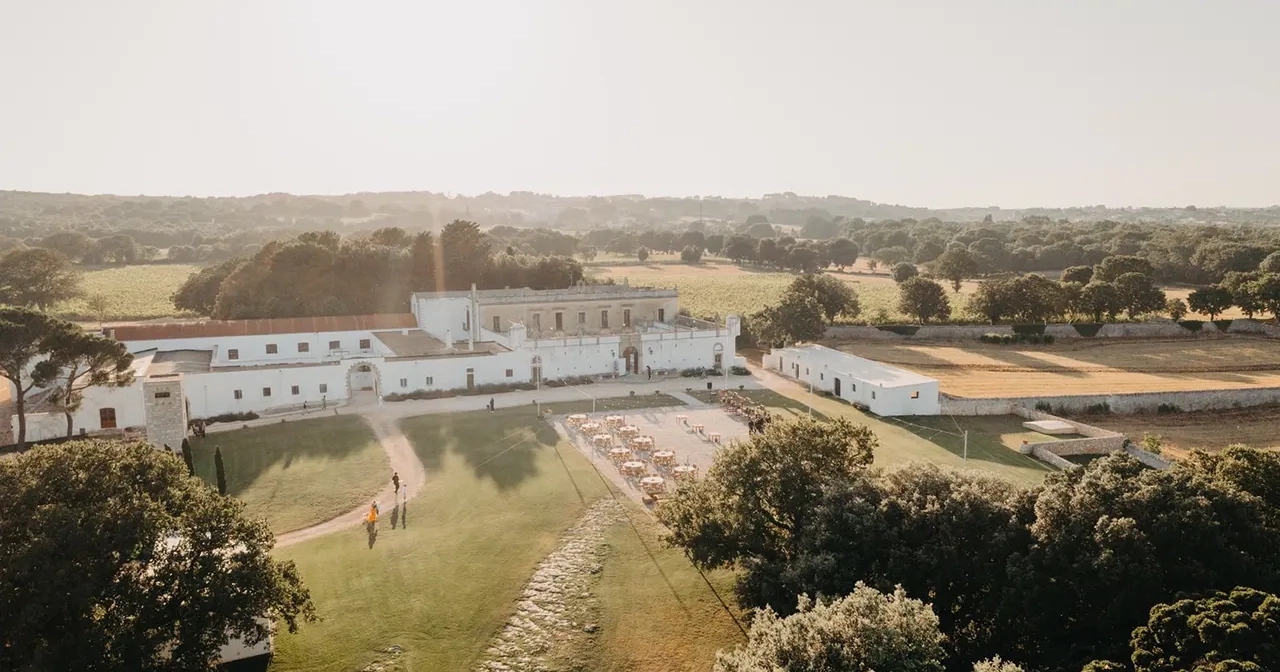
The original seventeenth-century nucleus of the complex was organised around a quadrangular courtyard paved with chianche — the thick martinese limestone slabs that are as specific to this territory as the dry-stone walls that border the property's fields, and that are listed as UNESCO heritage in their constructive tradition. The courtyard parapets are lined with stone statues of saints, commissioned by the noble family to protect all those who worked within the walls from theft and brigandage — a form of architectural devotion that is entirely characteristic of the relationship between faith, power, and daily life in seventeenth-century Puglia. The external walls carry loopholes and stone rings for tying horses. Sentry boxes flank the corners. This is not a decorative vocabulary imported from somewhere else. It is the specific security architecture of a fortified Puglian estate, built at a moment when the countryside around Martina Franca was dangerous enough that a noble family needed to make that danger visible in stone. Today, the courtyard is one of the most atmospherically concentrated outdoor spaces available for a wedding dinner in this part of the Valle d'Itria: enclosed, historic, lit by candlelight under an open sky.
The Stable, the Milking Room, and the Aia: Agricultural Spaces Returned to Their Grandeur
Masseria Palesi is a working agricultural estate as well as a historic monument, and the spaces built for agricultural use are among the most visually compelling of all its environments. The large stable — where two native breeds of equine were raised, the cavallo murgese and the asino martinese, the largest Italian donkey breed — has been restored to its original character: exposed stone walls, vaulted ceilings, the proportions of a space built to house large and powerful animals. It can accommodate around 200 guests for a seated reception. A late nineteenth-century milking room adds a further indoor space with its own distinct period character. The aia — the great paved threshing floor where grain was separated from chaff after the harvest — is one of the most expansive outdoor spaces on the estate, available for the live cooking village fair format that the estate calls a festa di paese: Puglian specialities prepared in front of the guests, over fire, in the open air, before the formal dinner begins. This is not a stylised reference to rural tradition. It is the actual tradition, performed in the actual space where the agricultural work of the estate took place.
When the wine at your wedding dinner was made on the same land where you got married, does that change how it tastes?
Masseria Palesi produces its own biological wines from fourteen hectares of organic vines on the estate. The harvest is done by hand, at dawn. The wine served at your celebration comes from these specific fields, these specific grapes, this specific piece of the Valle d'Itria.
How Francesco worksThe Vineyard, the Organic Wines, and the Oak Forest
Cantine Palesi — the estate's winery — is built on fourteen hectares of organic vineyards managed by the Albergo family, who have farmed this land for years with a commitment to biological viticulture: no synthetic fertilisers, no chemical pesticides, manual grape harvesting at dawn to preserve the integrity of the fruit. The wines produced here are a direct expression of this specific agricultural territory, of the particular terroir of the Valle d'Itria at altitude near Martina Franca, and of the family's own long-standing relationship with this land. For a wedding at Masseria Palesi, the wine served at dinner can come from the estate's own production — grapes grown metres from the courtyard where the celebration takes place, vinified in a cantina that forms part of the same historic complex. This is a level of agricultural coherence between venue and table that very few properties in Puglia can offer.
The oak forest that surrounds the masseria — centuries-old oaks and holm oaks whose canopy creates an enclosed, shaded world on the edges of the estate — is equally distinctive. Among its trees are the ceremony settings that the estate calls the querceto: the trullo area, a small courtyard with a green lawn surrounded by magnificent oaks, and the shade of the ancient trees themselves. These are not ceremony settings of the open, luminous kind that characterise most Puglian outdoor weddings. They are introverted, sheltered, deeply rooted in a specific and unusual landscape.
The Civil Ceremony: Casa Comunale of Martina Franca
Masseria Palesi holds the official status of casa comunale — meaning that legal civil ceremonies can take place directly on the estate. The available ceremony locations are genuinely varied: the frescoed eighteenth-century palazzo, the enclosed sunny garden, the shade of the oak grove, and the trullo area with its lawn and surrounding oaks. This range gives couples a choice between interior and exterior, intimate and expansive, architectural and natural — all within the same property, all legally authorised for the ceremony. For foreign nationals, this does not eliminate the need to prepare documentation in advance through the Italian consulate in your country of residence, with requirements varying by nationality and the process typically starting several months before the date. A locally based wedding coordinator experienced with international couples is the most reliable guide through this process.
Getting to Masseria Palesi: Practical Information for International Couples
Masseria Palesi is located on the Strada Vecchia per Crispiano, zona F 144/A, 74015 Martina Franca, province of Taranto. Taranto Airport is the closest, though Bari and Brindisi airports are both accessible and serve a wider range of international routes. Martina Franca — the principal town of the Valle d'Itria, known for its Baroque architecture and the Festival della Valle d'Itria held each summer — is immediately nearby. Alberobello, Locorotondo, and Cisternino are all within easy reach. For guests arriving for a multi-day wedding who want to explore the territory, the Valle d'Itria from Martina Franca offers a different perspective from the more coastal experience of Fasano or Ostuni: cooler, elevated, more agricultural in character, with the Murge plateau to the north and the olive plain below.
Masseria Palesi: Questions From Couples Planning a Wedding in the Valle d'Itria
How does the legal wedding process work for foreign couples at Masseria Palesi?
Masseria Palesi is officially designated as a casa comunale, which means legal civil ceremonies can take place on the estate itself — in the frescoed palace, the enclosed garden, the oak grove, or the trullo courtyard — without requiring a separate visit to the Comune di Martina Franca. For foreign nationals, the documentation process must begin several months before the wedding through the Italian consulate in your country of residence, with exact requirements varying by nationality. Confirming the specific administrative steps with a locally based wedding coordinator is strongly recommended.
What makes this estate unusual compared to other masseriae near Martina Franca?
Several things converge here that are genuinely rare in combination. The Baroque architectural decoration — the sculpted portal, the stone saints on the courtyard parapets, the frescoed interior salons — is of a quality and specificity unusual at any working agricultural estate. The organic vineyard producing Cantine Palesi wines means the wine at the wedding can come from the estate's own fourteen hectares of land. And the oak and holm oak forest that surrounds the property gives this estate a landscape register — darker, more enclosed, more of the Murge plateau than of the olive coast — that is entirely its own.
What is the indoor capacity of the estate for a seated wedding dinner?
The large restored stable accommodates around 200 guests for a seated reception. The frescoed salons of the palazzo and the late nineteenth-century milking room provide additional interior spaces for smaller gatherings, ceremonies, or moments that need a different kind of room. The combination gives the estate genuine flexibility across different scales and formats.
Is accommodation available on site for the wedding night and wedding party?
The venue hire includes one night in the bridal suite with breakfast. Beyond the bridal suite, the masseria has two double rooms, one triple room, and one quadruple room — accommodating a total of eleven guests on site. There is no obligation to fill all the rooms and no minimum stay requirement. For larger wedding parties, the estate can recommend partner masseriae approximately five minutes away by car, with around eighty rooms available between them.
Can the wine served at the wedding come from the estate's own vineyard?
Yes. Cantine Palesi produces biological wines from fourteen hectares of organic vines on the estate, with manual grape harvesting at dawn to preserve quality. The wines are an expression of this specific agricultural territory and the Albergo family's long-standing viticultural project. Confirming the wine service arrangements directly with the estate team is the right way to integrate this into the wedding planning.
What is the live cooking village fair format mentioned by the estate?
The festa di paese is a format specific to this estate that opens the wedding celebration with Puglian specialities prepared live — cooked in front of the guests in the open air of the aia or the oak grove, in the manner of a traditional village festival. Typical local products are prepared fresh, on site, as guests arrive and begin to gather. It is a way of beginning the celebration with the most direct possible connection to the food traditions of this territory before the formal seated dinner begins.