Seventeen Kilometres from Florence, Eight Centuries of History: Getting Married at Castello Il Palagio in Chianti
When the Medici family regained control of Florence in 1530 — ending the last Florentine Republic and beginning the principality that would eventually become the Grand Duchy of Tuscany — the political landscape of the territory surrounding the city changed with it. Castello Il Palagio, which had served as a stronghold of the Florentine Republic for over two centuries along the fortified line running from San Casciano to Sant'Andrea a Fabbrica, was given to the Canigiani family in 1563 as part of that reordering. In the seventeenth century, it passed to the Miniati di Dino family, who transformed it from a military fortification into a mansion: decorating it with art, enlarging the garden in the Italian style, planting the trees around the walls that would reach their peak beauty in the seventeenth and eighteenth centuries, and giving the castle the final character that it carries today. This is the history of a building whose existence is inseparable from the political history of Florence — a building that was already standing when Dante was alive, in the same Chianti countryside, 17 kilometres from the city that shaped European culture for three centuries. For international couples planning a destination wedding near Florence who want a venue whose connection to that history is structural rather than decorative, Castello Il Palagio at San Casciano Val di Pesa is one of the most directly and specifically Florentine places available anywhere in the Chianti area.
I work regularly as a wedding photographer in and around Florence, and the Chianti corridor between Florence and Siena is a territory I know well — its specific quality of light in the afternoon, the way the vine rows structure the view from the hills, the particular register of the medieval villages and towers that punctuate this landscape. Castello Il Palagio sits within this territory with the specific authority of a building that predates the landscape's romantic reputation by several centuries. It was here before the Grand Tour made Chianti famous. It was here before Tuscany was a destination.
From 1252 to the Present: The Castle and the Land Before It
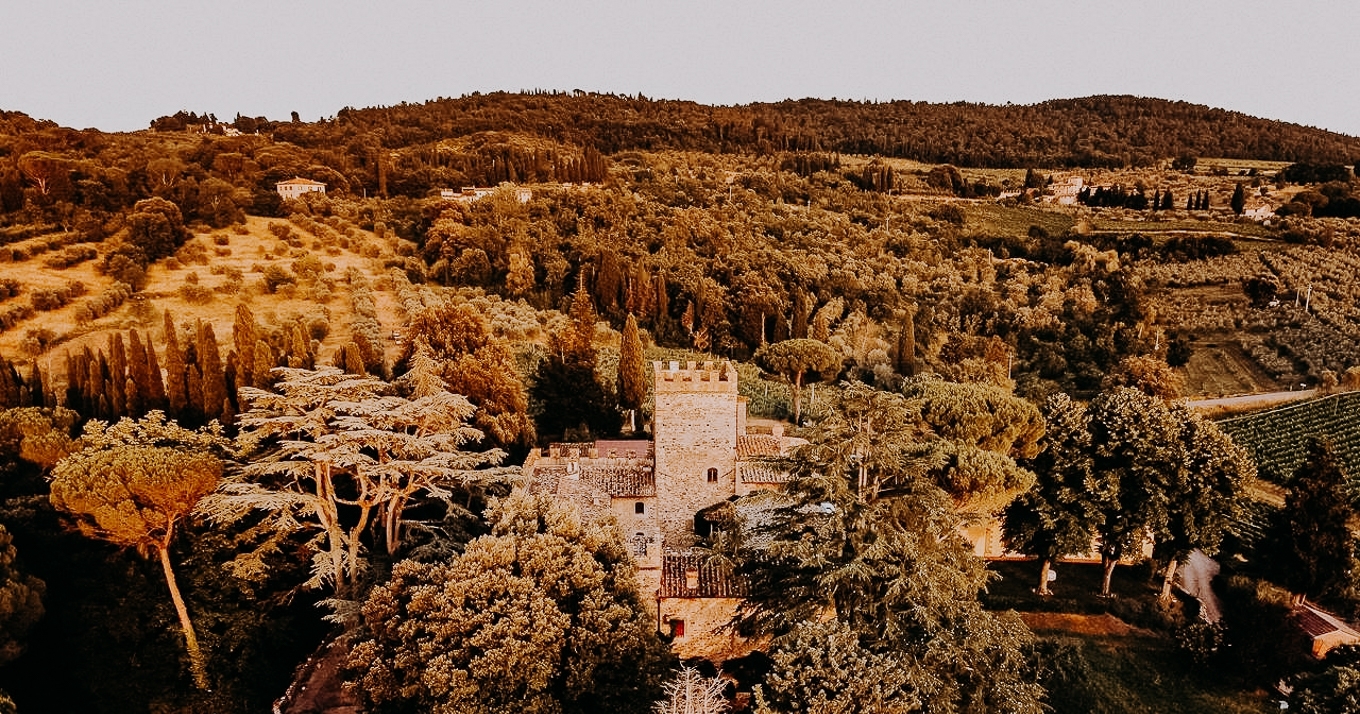
The castle's documented history begins around 1252, though the estate notes that the surrounding area contains Etruscan and then Roman settlements that predate the medieval structure — which suggests the strategic value of this position was recognised long before anyone thought to build a fortified tower on it. The keep — the tall central tower that has withstood the test of time while more recent buildings around it have not — is the visual centrepiece of the castle from the outside and the physical reality that guests sit beneath in the main courtyard. In 1320 the castle was enlarged to nearly double its original size, reinforcing its position as a defensive stronghold and extending its capacity for offensive action in the contested territory between Florence and Siena. That history of enlargement and military purpose is present in the thickness of the walls, in the proportions of the courtyard, and in the loggia that runs along one side of the main outdoor space — buildings that were made to last, that were made to hold, and that have.
The Courtyard, the Loggia, the Keep: The Architecture of the Celebration
The main courtyard of Castello Il Palagio — 185 square metres, covered on one side by the loggia — is the primary event space of the castle and can accommodate up to 180 guests. It is the space where the keep casts its shadow in the afternoon, where the torches and hundreds of candles described by the estate create, at night, an atmosphere that no lighting designer could approximate with contemporary equipment. The loggia, at 50 square metres, functions as the music platform — the estate specifically notes its wonderful acoustics, which makes it ideal for a live band — and as a sheltered transition space between the courtyard and the interior rooms.
Inside, the castle distributes its guests across a sequence of rooms of different scales and different characters. The Hall of Arms — 74 square metres, with an antique fireplace and two monumental family trees that are its signature decorative element — can seat 70 guests at round tables, 50 at an imperial table, or 100 in an auditorium configuration. The Guard of the Courtyard, the front room adjacent to it, adds 30 more seated places and functions as an ideal aperitivo space. On the first floor, the Red Hall overlooks the courtyard and the Chianti countryside beyond it — 30 square metres, ancestor paintings on the walls, the kind of room where the word lineage is not a metaphor but a visible presence. The Yellow Hall, accessible from the stairway to the veranda overlooking the courtyard, adds another 32 seats. These rooms do not feel like event spaces that have been installed in a historic building. They are the building, furnished and inhabited as they have been for centuries.
The Chapel: A Consecrated Space Inside the Courtyard Walls
Within the castle's courtyard stands its private chapel — small, consecrated, and intimate in the specific way that private chapels in historic Tuscan properties are intimate: not designed for a congregation but for the family that inhabited the castle and the community that surrounded it. Civil ceremonies are now also possible at the castle, giving couples the full range of options — symbolic, religious, or legally binding civil — within the same property. The chapel can be decorated with flowers, lights, and seating arrangements according to the couple's wishes. For international couples who want a religious ceremony in a genuinely historic sacred space rather than in a rented church, the chapel at Castello Il Palagio is one of the most historically charged options available within the Florentine Chianti area.
The Garden, the Driveway, and the Italian Park
The garden at Castello Il Palagio was planted and shaped in the seventeenth and eighteenth centuries, when the Miniati di Dino family transformed the military castle into a mansion and extended the park until it reached what the estate describes as its peak beauty. The trees planted at that time are now centuries old. The garden is designed all'italiana — the formal Italian style, with geometric order, clipped hedges, and the particular combination of shadow and perspective that this tradition produces at its best. The driveway that leads to the castle — described by the estate as magical — gives guests their first view of the tower and the facade through a sequence of trees that frames the arrival in a way that the more direct approaches of modern venues cannot replicate. For the photography, this entrance sequence is one of the most complete available at any venue in the Chianti area: the driveway, the tower, the courtyard, the garden, and the hills of Chianti visible beyond the walls at every outdoor position.
When the Medici changed who owned this castle in 1563, were they imagining it would host weddings for international couples five centuries later?
History has a way of finding uses for the buildings it cannot destroy. Castello Il Palagio was a Republic stronghold, then a military fortress, then a nobleman's mansion. Now it is a wedding venue, 17 kilometres from Florence, with the keep still standing and the ancestor portraits still on the walls. Working here as a photographer means working inside eight centuries of decisions made by other people about what this place should be.
How Francesco worksGetting to Castello Il Palagio: Practical Information for International Couples
Castello Il Palagio is located at Via Campoli 96/98, 50026 San Casciano Val di Pesa, in the province of Florence. At 17 kilometres from Florence, it is one of the most accessible castle wedding venues in Tuscany for international guests arriving at Florence Airport — a short taxi or transfer ride from the city centre, and within comfortable reach of the main Chianti wine route between Florence and Siena. San Casciano Val di Pesa is itself a characteristic Chianti hill town with its own medieval character and wine production history. Greve in Chianti, Panzano, Radda, and Castellina are all accessible for day trips along the Chiantigiana road. Siena is reachable to the south. For guests combining a wedding stay with Florence — the Uffizi, the Duomo, the Oltrarno, the markets — the proximity of the castle to the city means that the cultural programme of the stay can be organised around the celebration without logistical compromise.
Castello Il Palagio: Questions From Couples Planning a Wedding in the Chianti Countryside
How does the legal wedding process work for foreign couples getting married at Castello Il Palagio?
Civil ceremonies are now available directly at Castello Il Palagio, in addition to symbolic rites and religious ceremonies in the chapel. For foreign nationals wishing to marry legally in Italy, the documentation process begins through the Italian consulate in your country of residence several months before the wedding date, with requirements varying by nationality. The castle team can advise on the specific administrative requirements for a civil ceremony at the venue and provide guidance for international couples navigating the Italian marriage registration process. Religious ceremonies in the consecrated chapel are an additional option for couples seeking a spiritual setting within the castle grounds.
What is the maximum capacity of the castle for a wedding reception?
The main courtyard with its loggia accommodates up to 180 guests. The interior rooms — the Hall of Arms, the Guard of the Courtyard, the Red Hall, and the Yellow Hall — offer additional space for seated dinners and can be combined in different configurations depending on the size and format of the celebration. The Hall of Arms alone seats 70 guests at round tables or 50 at an imperial table. The rooms can also be transformed into dancing spaces during the evening. The castle team adapts the layout of spaces to each event's specific requirements, using tents, covers, tables, and seating as needed.
What is the significance of the two monumental family trees in the Hall of Arms?
The two monumental family trees displayed in the Hall of Arms are genealogical documents in decorative form — the visual representation of the noble lineages associated with the castle's history, a tradition of aristocratic self-documentation that was common in the great Tuscan houses of the seventeenth and eighteenth centuries. They are, in the context of a wedding celebration, an unusually pointed backdrop: the recorded history of the families who came before, alongside the beginning of a new family story. Few wedding venues in Chianti offer a room where this kind of historical depth is literally present on the walls.
Is there accommodation on site at Castello Il Palagio?
The castle itself does not function as a hotel with guest rooms available for the wedding party. Accommodation is available in the surrounding San Casciano Val di Pesa area and across the broader Chianti territory, with the castle team able to recommend suitable options for different group sizes and budgets. The proximity to Florence also means that guests staying in the city can reach the castle easily for the celebration and return to Florence in the evening.
What role did the Medici family play in the history of Castello Il Palagio?
After the Medici family regained control of Florence in 1530, ending the last Florentine Republic, the political landscape of the surrounding territory was restructured. Castello Il Palagio, which had served as a stronghold of the Republic for over two centuries, was given to the Canigiani family in 1563 as part of this restructuring. The castle's subsequent history — its transformation into a mansion by the Miniati di Dino family in the seventeenth century, the enlargement of the garden, the introduction of art and furnishings — took place within the political and cultural framework of the Medici Grand Duchy of Tuscany, a period that shaped the visual character of the estate as it exists today.