The Castle That Giovanni Verga Named in His Novels: Getting Married at Castello Camemi Near Vizzini
There is a small number of places in Italy where a specific building appears, named, in a canonical work of national literature. Castello Camemi in Contrada Camemi, near Vizzini Scalo in the province of Catania, is one of them. Giovanni Verga — the founder of Verismo, author of I Malavoglia and Mastro Don Gesualdo, one of the most significant Italian writers of the nineteenth century — cited this castle in his novel Mastro Don Gesualdo and in the tale Pane nero. The fact is not incidental. Verga was of Vizzini — his family came from this specific town in the Catanian interior, and the territory in which Castello Camemi sits is the territory of his imagination and his most important fiction. When he wrote about the landscape, the social structures, and the physical places of this corner of eastern Sicily, he was writing about a world he knew from the ground up. The castle that appears in his pages is the castle that was here, that was rebuilt after the earthquake of 1693, that had been a fortification since the fourteenth century and the summer residence of the viceroys for four centuries: this specific building, this specific place, on the hills of the Val di Noto UNESCO World Heritage area. For international couples planning a destination wedding in Sicily who want a venue where history is documented not only in stone but in literature — where the land itself has been written about by one of the great Italian realist writers — Castello Camemi occupies a position in the Sicilian wedding landscape that is genuinely singular.
I photograph weddings across eastern Sicily and the Val di Noto, and the inland Catanian countryside around Vizzini — less visited than the Baroque coast, less famous than Etna, entirely itself — produces a quality of light and a depth of agricultural landscape that the more touristically concentrated areas do not have. The hills here are the hills of Verga's fiction, and working in them with a camera produces images that carry the weight of that landscape without any additional effort.
The Ventimiglia, the Viceroys, and Seven Centuries of History
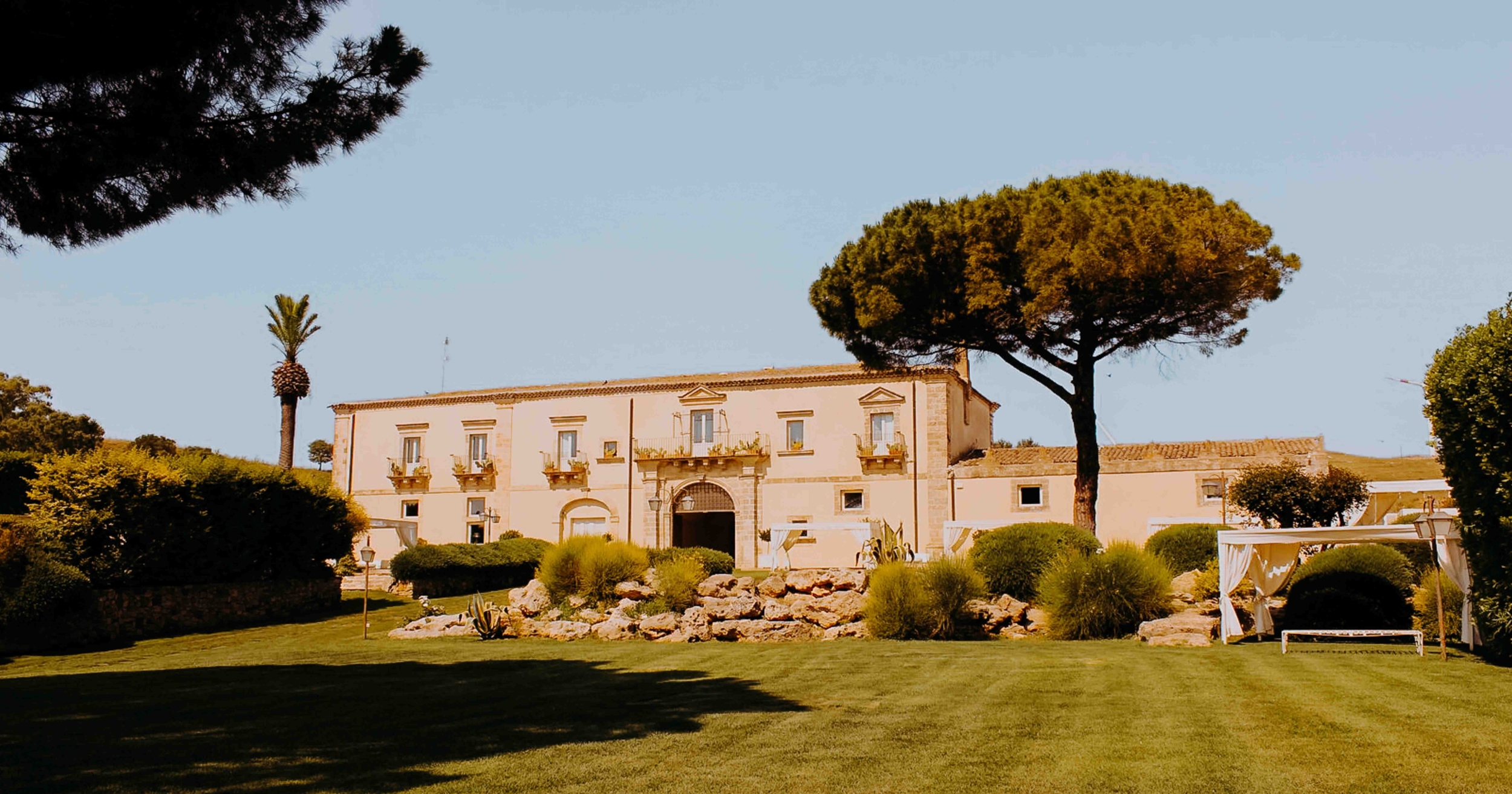
Castello Camemi's documented history begins in the fourteenth century as a fortification of the noble Ventimiglia family — one of the most powerful aristocratic families in medieval Sicily, whose domain at its peak extended over half the island, from the Madonie mountains to the foothills of the Nebrodi. They owned the castles of Geraci, Gangi, Castelbuono, and Buscemi, and held the principalities of Belmonte, Buonriposo, Castelbuono, Grammonte, and Ventimiglia. At the beginning of the Aragonese period they were powerful enough to oppose the king himself, in alliance with other noble families. From 1412 until 1830 — a span of more than four centuries — Castello Camemi served as the summer residence of the viceroys of Sicily: the representatives of the Spanish Crown who governed the island on behalf of the monarch. The earthquake of 1693, which destroyed a large part of eastern Sicily and led to the wholesale reconstruction of the cities that became the Baroque Val di Noto, also brought down Castello Camemi. The castle that stands today was rebuilt in the eighteenth century on the same foundation, in the same square plan, with the same merlons and triumphal arch entrance. The restoration carried out in recent years, using original materials and bio-architecture principles, recovered the castle's historic fabric without replacing it with a simulation.
The Square Plan, the Triumphal Arch, and the Ancient Carob Tree
The architecture of Castello Camemi follows the square plan that characterises the defensive buildings of this period: a majestic facade adorned with merlons, a triumphal arch that opens through the carriage entrance into an inner courtyard, the piano nobile on the upper floor where the rooms of greatest architectural distinction are found. The courtyard has flagstone pathways converging on its centre point, which is occupied by an ancient carob tree — described by the castle itself as the heart and symbol of the whole property. The carob is one of the oldest and most characteristically Sicilian trees: its deep roots, its wide canopy, its summer shade, and its autumn pods are features of the inland Sicilian landscape that Verga knew and described as well as any writer has. The fact that the courtyard of this castle centres on a carob tree is not a design decision but an inheritance, an accumulation of centuries, the kind of thing that happens to a place rather than being done to it.
The charming hall inside the castle — with its medieval architecture, its classic furniture, and the great old fireplace that draws guests around it in the colder months — continues the experience of the interior: a building whose spaces hold the quality of having been inhabited continuously, whose proportions and materials were determined by the purposes they served and not by any decorative brief.
The Fourteen Rooms and the Gardens
The fourteen rooms of Castello Camemi are each distinct, furnished with the individuality that a boutique hotel in a historic castle naturally develops when the spaces themselves are not uniform. The room categories — Imperial Suites, Junior Suites, Superior Suites, and Classic Rooms — all feature stone floors, private bathrooms, and the contemporary amenities that a five-star boutique hotel provides. The suites include private living rooms and, in many cases, a fireplace or a Jacuzzi. Outside, the terraced garden, the pool, the solarium set in a lush lawn, and the two gardens give the castle an outdoor world that moves from the enclosed intimacy of the courtyard to the open country scenery of the Val di Noto hills. The castle's own description — "a pristine environment" — is accurate in the sense that the agricultural landscape surrounding it has not been developed or managed for a tourism market and retains the character of the territory that Verga described.
The Restaurant and the Event Spaces
The restaurant at Castello Camemi serves a lavish buffet breakfast daily and offers lunch and dinner menus built on fresh, local ingredients carefully selected by the chef. For weddings, the spaces of the castle accommodate both intimate celebrations and large gatherings: the restaurant hall can host from a small number of guests to several hundreds depending on its configuration. The old fireplace lounge in the main hall and the classic-style lounge at the piano nobile provide warm indoor gathering spaces in winter. The courtyard, with the carob tree at its centre, evokes the country-style and noble ambiance of the castle's past while the terrace, pool, and gardens provide the full range of outdoor options for summer celebrations. The castle describes its events philosophy simply: the beauty of the spaces, the gourmet cuisine, the varied buffet menus, and the professionalism of the staff are the three elements that make each event successful.
What does it mean to get married in a castle that appeared in a novel by one of Italy's greatest writers?
Verga wrote about this specific place because he knew this specific territory. The ancient carob in the courtyard, the medieval walls, the landscape of the Val di Noto hills: these are not props for a wedding. They are the material of a literary imagination that shaped Italian narrative for a century. Photographing a wedding here means working in a place that was already seen, already described, already made specific by the act of writing.
How Francesco worksGetting to Castello Camemi: Practical Information for International Couples
Castello Camemi is located at Contrada Camemi, Vizzini Scalo, province of Catania. Catania Fontanarossa Airport is the most convenient international gateway, at approximately one hour by car through the Catanian interior. The castle sits in the hills of the Val di Noto, which is a UNESCO World Heritage Site for its Baroque urban architecture — the cities rebuilt after the 1693 earthquake that also brought down and subsequently reconstructed Castello Camemi itself. Caltagirone, the ceramic city, is in the same area. The Baroque towns of Noto, Ragusa Ibla, Modica, and Scicli are accessible to the south. Syracuse is reachable from the east. The town of Vizzini — whose famous son Giovanni Verga set so many of his most important works in this territory — is minutes from the property. For guests who have not explored the inland Catanian countryside, the combination of the Verga literary landscape, the Val di Noto Baroque heritage, and the agricultural interior that is so different from the coastal Sicily most international visitors know gives this part of the island a cultural depth and a quality of genuine discovery that is increasingly rare.
Castello Camemi: Questions From Couples Planning a Wedding in Eastern Sicily's Historic Interior
How does the legal wedding process work for foreign couples getting married at Castello Camemi?
Foreign nationals wishing to marry legally in Italy must begin the documentation process through the Italian consulate in their country of residence several months before the wedding date, with requirements varying by nationality. Whether a civil ceremony can take place directly at the castle or requires a visit to the Comune di Vizzini is something to confirm with the Castello Camemi team. The castle has a professional events staff experienced in organising weddings for guests from across the world and can advise on the administrative requirements for international couples throughout the planning process.
What is the connection between Castello Camemi and Giovanni Verga?
Giovanni Verga (1840–1922) was one of the most important Italian writers of the nineteenth century, the founder of Verismo literary movement and the author of I Malavoglia and Mastro Don Gesualdo — works of major significance in Italian literary history, the latter adapted by director Luchino Visconti for his 1948 film La Terra Trema. Verga's family came from Vizzini, the town immediately near Castello Camemi, and the landscape of the Catanian interior surrounding the castle is the physical territory of his most important fiction. The castle is cited by name in Mastro Don Gesualdo and in the tale Pane nero, meaning that this specific building — the one rebuilt after the 1693 earthquake, whose ancient carob stands in the central courtyard — exists within the literary record of Verga's Vizzini-based narrative world.
What happened in the 1693 earthquake and how did it affect Castello Camemi?
The earthquake of January 11, 1693 was one of the most devastating seismic events in European history, destroying a vast area of eastern Sicily including the cities of Catania, Noto, Ragusa, Modica, and dozens of smaller towns. The reconstruction that followed produced the extraordinary Baroque urban fabric now protected as a UNESCO World Heritage Site. Castello Camemi was destroyed in the earthquake along with much of the surrounding territory and was subsequently rebuilt in the eighteenth century — which is why the structure that stands today, while built on the foundations and in the plan of a fourteenth-century fortification, is largely an eighteenth-century reconstruction.
How many rooms and suites does the castle have?
Castello Camemi has fourteen rooms and suites across four categories: Imperial Suites, Junior Suites, Superior Suites, and Classic Rooms. All feature stone floors, private bathrooms, television, safe, and WiFi. The suites include a separate living room and, in many cases, a fireplace or Jacuzzi. The castle operates as a five-star boutique hotel and the accommodation experience is that of a genuinely historic building made comfortable for contemporary guests.
Is the Val di Noto UNESCO heritage accessible from the castle?
Yes. Castello Camemi sits in the hills of the Val di Noto, the area whose cities were reconstructed in Baroque style after the 1693 earthquake and were inscribed on UNESCO's World Heritage List for their extraordinary architectural heritage. Caltagirone, Noto, Ragusa Ibla, Modica, Scicli, and the surrounding Baroque towns are all accessible within a comfortable driving distance from the castle. For international guests who want to combine a wedding stay with an exploration of the most culturally concentrated area of eastern Sicily, this position is exceptional.