Red and White Checkerboard Tiles, an Olive Grove of Two Thousand Trees, and a Chef Trained by Michelin Stars: Braccialieri Near Noto
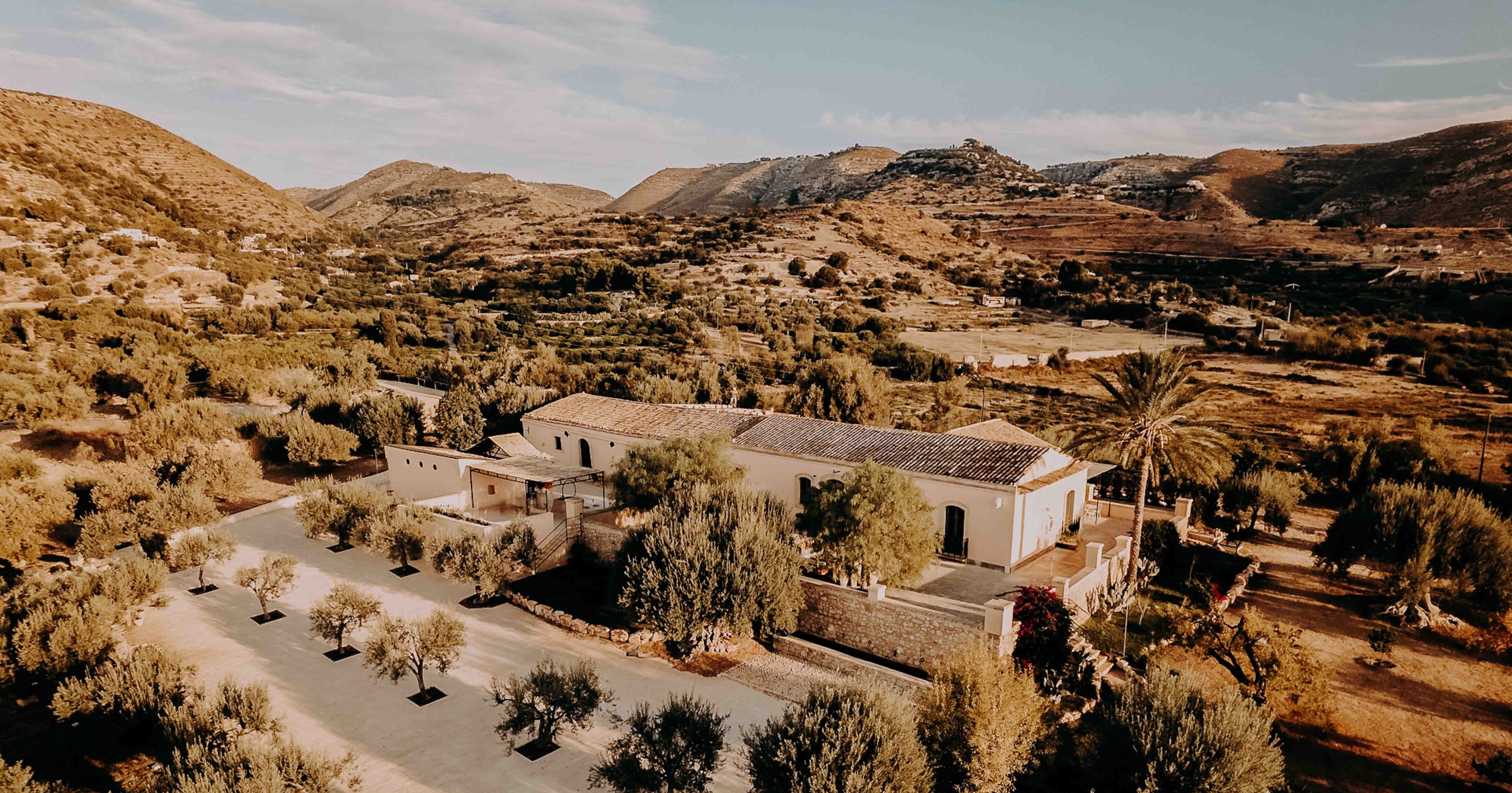
The pool at Braccialieri is paved in red and white checkerboard tiles. This is not an accident and not a detail — it is a declaration of intent by Alessandro Enriquez, the Sicilian designer who conceived and realised the aesthetic of this entire estate: a statement that the visual language here will be confident, specific, and entirely unlike anything available at the heritage-restoration venues that populate the destination wedding landscape of southern Italy. Braccialieri sits two kilometres from Noto — the UNESCO-listed Baroque city that is, at sunset, one of the most photographed urban landscapes in Sicily — on the hills of Avola, in the province of Siracusa, within a grove of more than two thousand centuries-old olive trees that the estate itself describes as an archaeological olive grove. For international couples planning a destination wedding in Sicily who want a venue where the design intelligence is as present and as intentional as the historical fabric — where Cassina and Cappellini meet a nineteenth-century palmento and an ancient Sicilian hearth — this is a destination wedding venue of a genuinely different order.
I photograph across eastern Sicily, and the specific light of the Val di Noto in this corner of the island — the warm amber of the Baroque stone, the silver of the ancient olive leaves, the intensity of the summer afternoons — is unlike anything I find elsewhere in my work. As a wedding photographer in Sicily, I return to the area around Noto and Avola repeatedly, because the quality of the light here, combined with the right architectural environment, produces images that feel complete without effort. Braccialieri, with its mix of old stone and deliberate design, its grove and its pool and its eco villas among the olive trees, gives that light an unusually wide range of surfaces to work with.
Alessandro Enriquez and the Design Vision of the Estate
Braccialieri was conceived and built by the Cancemi family — brothers Tonio and Peppe, Sicilian entrepreneurs with a background in entertainment — and the visual identity of the whole project was designed by Alessandro Enriquez, a Sicilian designer who has collaborated with some of the most significant names in Italian furniture and design: Cassina, Vispring, Cappellini, Casa Lago, Tom Dixon. The brief Enriquez brought to this estate was not the conventional one of heritage restoration — recover the original materials, restore the original proportions, make the old building look as it did in its best moment. It was something more interesting: take a working nineteenth-century agricultural estate, the old kitchen with its tannura, the master's house, the farmhands' spaces, the palmento where grapes were pressed, and build within and around them a visual world that is unmistakably Sicilian, contemporary in its references, and confident enough in its aesthetic to use a checkerboard pool as a centrepiece without apology. The result is a property where every surface carries a design decision, where the furniture is named and consequential (Cassina chairs in the suites, Cappellini pieces throughout), and where the relationship between the old stone of the original estate and the contemporary design language that now inhabits it is the defining experience of a stay.
The Suites: Tannura, Baglio, and the Master Miller's Room
The three luxury suites are housed in the oldest part of the estate and named with the same poetic specificity that runs through every naming decision at Braccialieri. The Pool Suite Amare occupies what was once the estate kitchen — the ancient Sicilian tannura, the domestic hearth that was the physical and emotional centre of every Sicilian rural household, is preserved within the room. The Deluxe Suite Tangerine (40 square metres) looks out onto the ancient baglio — the internal courtyard of the original building — with antique floors that retain the physical evidence of the room's past life, combined with contemporary pieces by Cassina and Cappellini that work against rather than with the historical material, creating the productive tension that is the signature of Enriquez's design language. The Junior Suite Geranium (32 square metres), in the old patronal house next to the palmento, was once the resting place of the master miller — the man who oversaw the pressing of the grapes. All three suites are distinct in colour and character, all three are in the most historically charged part of the property, and all three have been furnished with the intelligence of a designer who understands what old rooms want from contemporary objects.
Six Eco Villas in the Archaeological Olive Grove
The six eco glamping villas — Domus Salvia, Rubinia, Flamma, Aurea, Solis, Viridis — are distributed through the olive grove as if, as the estate puts it, they were spontaneous vegetation: structures that emerged from the landscape rather than being placed within it. Each villa has its own private veranda with views across the Val di Noto toward the sea and the hills, its own private outdoor space, and the particular quality of being enclosed by olive trees that are centuries old and that carry in their scale and their presence the weight of everything that has grown and been harvested here for generations. Some villas have Finnish tubs on their verandas; some have olive wood-fired water tanks. The sustainability logic of the property — water conservation, eco-friendly materials — runs through every villa. For a wedding where the guest accommodation is not a secondary consideration but part of the celebration itself, the combination of the three suites in the historic building and the six eco villas in the grove gives Braccialieri a total accommodation offering of nine units, each entirely distinct in character and setting.
Is a checkerboard pool too much for a wedding, or exactly the right amount?
Design takes a position. At Braccialieri, every visual choice — from the pool tiles to the suite names to the Cassina chairs in the rooms — is the result of a single coherent design intelligence. Photographing a wedding in that kind of environment requires the same kind of positional clarity: knowing when the design is the subject, and when the people are.
How Francesco worksDodici Zappe: A Nineteenth-Century Mill, a Chef, and a Farming Measurement
The restaurant at Braccialieri is called Dodici Zappe — twelve hoes — a name that references an ancient unit of agricultural measurement specific to this territory: the amount of land a worker could turn in a day with a hoe. The restaurant is housed in the estate's original nineteenth-century palmento, a stone-vaulted mill building whose walls and floors retain the character of the original agricultural function and whose low, intimate lighting turns dinner here into a specifically interior experience, sheltered from the Sicilian night outside. The chef is Francesco Giura, who trained under Michelin-starred chefs and whose cooking is built on the same zero-kilometre logic that runs through the estate's wider identity: locally sourced ingredients, the olive oil produced from the grove's own trees, the produce of the Val di Noto and the Siracusa coastline. Wedding receptions can take place in the palmento restaurant or outdoors among the eco villas, the baglio courtyard, and the checkerboard pool — the whole estate available in exclusive use for a single celebration.
Getting to Braccialieri: Practical Information for International Couples
Braccialieri is located at Contrada Seggio, 96012 Avola (Siracusa), five minutes from Noto and four kilometres from the town centre. Catania Fontanarossa Airport is approximately one hour away. Siracusa — with its ancient Greek quarter of Ortigia, the archaeological park, and one of the finest food scenes in eastern Sicily — is 30 kilometres to the north. The Cavagrande del Cassibile nature reserve, with its canyon and natural pools, is 12 kilometres away. The fishing village of Marzamemi, known for its red tuna tradition and its piazza, is a short drive to the south. Noto itself — UNESCO Baroque, honey-coloured stone, one of the best restaurant concentrations in Sicily — is effectively on the doorstep. For a destination wedding group arriving for several days, this position in the Val di Noto places the estate at the centre of one of the most culturally and gastronomically rich territories in all of Italy.
Braccialieri: Questions From Couples Planning a Destination Wedding Near Noto
How does the legal wedding process work for foreign couples getting married in Italy at Braccialieri?
Foreign nationals wishing to marry legally in Italy must begin the documentation process several months in advance through the Italian consulate in their country of residence, with requirements varying by nationality. Whether a civil ceremony can take place directly on the estate or requires a visit to the Comune di Avola or Comune di Noto is something to confirm with the Braccialieri team. Many international couples choose to complete the legal formalities separately and hold the full ceremony and reception on the estate, allowing the entire day to unfold within the property. A locally based wedding coordinator with experience in destination weddings for international couples is the most reliable guide through the administrative process.
Who is Alessandro Enriquez and what does his involvement mean for the experience of the property?
Alessandro Enriquez is a Sicilian designer and stylist who has collaborated with major Italian and international furniture and design brands including Cassina, Vispring, Cappellini, Casa Lago, and Tom Dixon. His involvement at Braccialieri means that the visual language of the estate — the suite interiors, the eco villa design, the pool, the outdoor spaces, the naming decisions — is the product of a single coherent creative intelligence rather than of an accumulation of restorations and decisions over time. The result is a property where staying, celebrating, and being photographed is a visually specific and consistently designed experience, different in kind from both the traditional heritage restoration and the generic luxury resort.
What is the eco glamping experience, and is it suitable for wedding guests?
The six eco villas at Braccialieri are independent structures set within the centuries-old olive grove, each with private verandas, views toward the sea and the hills, and the particular quality of being surrounded by trees that have been growing in this landscape for generations. Some have Finnish tubs; some have olive wood-fired water tanks on the verandas. The sustainability logic — water conservation, eco-friendly materials — is built into every detail. For wedding guests, staying in the eco villas is part of the immersive experience of the estate: not a budget alternative to the suites but a distinct and intentional way of inhabiting the olive grove, with its own quality of privacy, silence, and natural enclosure.
What is the Dodici Zappe restaurant, and is the food served at weddings from the same kitchen?
Dodici Zappe is Braccialieri's in-house restaurant, housed in the estate's nineteenth-century palmento mill building, with stone interiors and intimate lighting. Chef Francesco Giura, trained under Michelin-starred chefs, leads a kitchen built on zero-kilometre sourcing — the estate's own olive oil, locally produced ingredients from the Val di Noto and the Siracusa coastline, the agricultural produce of this specific territory. Wedding menus draw on the same kitchen and the same culinary philosophy. The name itself — twelve hoes, an old Sicilian agricultural measurement — signals the kitchen's relationship to the land and the working tradition of the estate.
What can a wedding party do in the Noto area during a multi-day stay at Braccialieri?
Noto, two kilometres from the estate, is a UNESCO World Heritage Site for its Baroque architecture — the honey-coloured stone buildings along Corso Vittorio Emanuele are among the most photographed in Sicily, particularly at sunset. Siracusa and the ancient Greek quarter of Ortigia are 30 kilometres away. The Cavagrande del Cassibile nature reserve, with its spectacular canyon and natural swimming pools, is 12 kilometres from the estate. Marzamemi, the fishing village famous for its red tuna and its atmospheric piazza, is a short drive to the south. Modica — chocolate, Baroque architecture, another UNESCO site — is also accessible. Braccialieri also hosts cooking classes on site, giving guests a more intimate engagement with Sicilian food culture without leaving the property.