Seven Spaces, One Estate: How Tenute Baglio Passofondo Reinvents the Western Sicily Wedding Venue
Most wedding venues offer a choice between inside and outside. Tenute Baglio Passofondo, a nineteenth-century baglio set in the hills surrounding Alcamo in western Sicily, offers seven distinct spaces — each with its own character, its own light, its own relationship to the landscape — and the possibility of moving a wedding celebration through several of them across the arc of a single day. The ceremony in the vineyard. The aperitivo in the carob garden. The dinner in the historic courtyard with its chiseled stone walls and wrought iron gate. The after-dinner in the Bottaia, the barrel room where the estate's wines age in darkness. For international couples planning a destination wedding in Sicily who want a celebration that changes register as the evening progresses — that has a visual and spatial narrative rather than a single fixed setting — this baglio on the road between Palermo and Trapani presents an offer that is genuinely unusual in the Sicilian wedding landscape.
I photograph weddings across western Sicily regularly, and the area around Alcamo and the hills above the Tyrrhenian coast produces a quality of agricultural landscape that is different from both the coastal resorts and the baroque inland towns: vine rows and olive groves across gently rolling terrain, the profile of the mountains behind, the sea occasionally visible in the far distance when the light is clear. It is a working landscape, not a scenic one, and it produces images with a texture and a groundedness that the more purely decorative venues cannot match.
The Nineteenth-Century Baglio and Its Quadrangular Courtyard
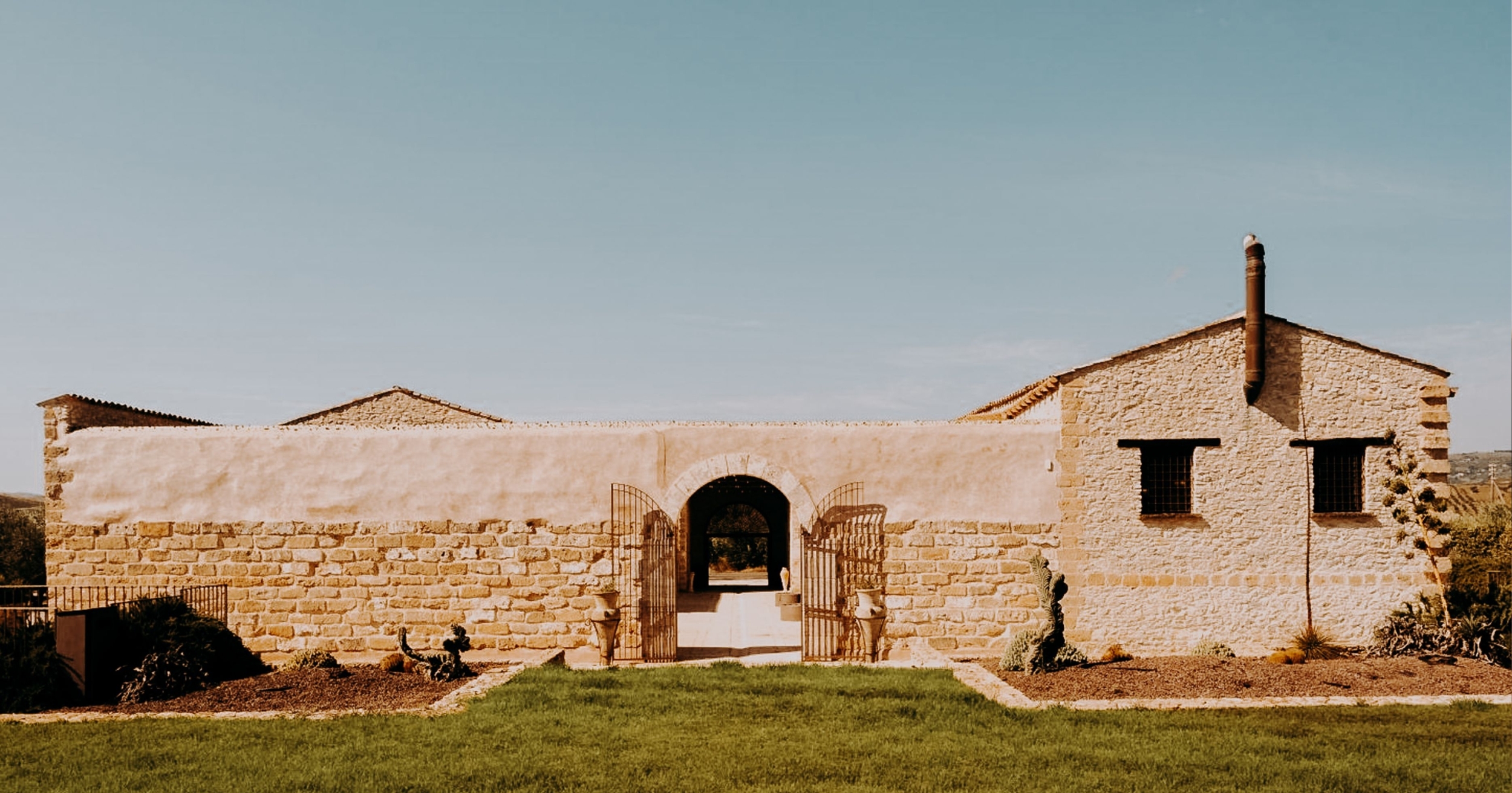
At the centre of the estate stands the original nineteenth-century baglio — the core architectural form of rural western Sicily — whose characteristic quadrangular courtyard is enclosed on all sides by stone buildings in chiseled local stone, with a wrought iron gate marking the passage between the enclosed world of the baglio and the open agricultural landscape beyond. This courtyard — the Corte della Dimora Storica — is one of the estate's primary outdoor event spaces: a space whose architecture is entirely the product of its original agricultural purpose, whose proportions were determined by the requirements of the working estate rather than by any decorative intention, and whose current role as a wedding setting derives its power precisely from this functional honesty. Stone tables, candlelight, the sky visible above the enclosed square of buildings: a dinner in the courtyard at Baglio Passofondo has the quality of something that has been happening in places like this in Sicily for two centuries, and the pleasure of that continuity is difficult to manufacture elsewhere.
Inside the baglio building, the ten suites offer accommodation for the wedding party within the historic fabric of the original structure. Exposed stone walls maintain the rooms naturally cool in the summer heat; contemporary design fireplaces provide warmth and romantic atmosphere in the cooler seasons. Some suites have Jacuzzi baths. All are air-conditioned and equipped with modern technology. The wellness area within the property provides an additional space for rest and recovery across a multi-day stay.
The Bottaia: Wine Barrel Room as After-Dinner Event Space
Of all the event spaces at Tenute Baglio Passofondo, the Bottaia is the one that has no equivalent at any other venue in this guide. A bottaia is a barrel ageing room — the space where wines mature in wood, in darkness, in the particular cool silence that barrel cellars maintain regardless of the season outside. At Baglio Passofondo this space has been made available as an indoor event venue: an intimate, enclosed room whose visual character is defined by the stacked barrels of the estate's own production, by the stone of the original construction, and by the quality of light and atmosphere that the underground wine world generates naturally. As an after-dinner space — for dessert, for toasts, for the late-evening gathering that a Sicilian wedding always produces — the Bottaia is unlike any indoor setting available at the coastal venues or the baroque estates of the southeast. It is cool, specific, and possessed of the kind of quiet drama that the agricultural heritage of this territory has deposited in its stones and barrels over generations.
The Vineyard, the Carob Garden, and the Panoramic Garden
The outdoor spaces at Baglio Passofondo are as varied as the indoor ones. The Vigneto — the vineyard itself, with its rows of Zibibbo, Catarratto, Calabrese, and the autochthonous Alcamo Bianco — is available as an outdoor event space, giving ceremonies and celebrations the particular quality of taking place within the working agricultural production of the estate rather than merely alongside it. The Uliveto extends the same logic to the olive grove: ceremonies and gatherings among ancient olive trees, whose scale and density give outdoor events a degree of natural enclosure and atmosphere that open gardens cannot provide.
The Giardino dei Carrubi — the carob garden — is a space specific to this corner of western Sicily. Carob trees, with their dark irregular forms and their distinctive pods and scent, are among the most characteristic plants of the Sicilian countryside west of Palermo, and a garden defined by their presence has a visual and olfactory character that is entirely of this territory. The Giardino ai Piedi del Vigneto occupies the most panoramic position on the estate, opening toward the gently rolling hills of the Alcamo countryside with the distant suggestion of the sea on the horizon: the space the estate recommends for events where the visual relationship between the celebration and the wider landscape is the defining quality of the setting.
Zibibbo, Catarratto, and the Alcamo Wine Territory
The vines at Tenute Baglio Passofondo are planted with varieties that are specific to this part of western Sicily and that carry the particular character of a territory whose viticultural history predates the modern wine industry by centuries. Zibibbo — the Muscat of Alexandria grape, brought to Sicily through the Arab period and used in the production of the great passito wines of Pantelleria — grows here in the continental conditions of the Alcamo hills with a different expression from its coastal counterpart. Catarratto, the dominant white grape of western Sicily, produces wines of mineral freshness and aromatic depth that reflect the altitude and the limestone-clay soils of this hillside position. Calabrese — the Nero d'Avola by another name — and the autochthonous Alcamo Bianco complete a portfolio that is, in its varietal composition, a precise map of where this estate sits in the Sicilian wine landscape. The wines produced from these vines are biological, and the estate offers guided tasting experiences and wine tourism itineraries — on foot or by bicycle through the vineyard rows — as part of its hospitality programming.
What does it mean to toast in a room where the wine you're drinking aged in the barrels around you?
The Bottaia at Baglio Passofondo is not a theme or a styling decision. It is the actual barrel ageing room of the estate. Photographing an after-dinner gathering in that space — the candlelight on the barrels, the stone walls, the faces of the guests — requires nothing added. It is already everything.
How Francesco worksGetting to Tenute Baglio Passofondo: Practical Information for International Couples
Tenute Baglio Passofondo is located on the Strada Provinciale 119, km 7, 91011 Alcamo, province of Trapani. The estate is accessible directly from the A29 Palermo-Mazara del Vallo motorway, making it one of the most logistically straightforward destination wedding venues in western Sicily for international guests arriving from either Palermo or Trapani airports, both of which are within comfortable driving distance. Alcamo itself — a hill town with a significant medieval and Baroque heritage, including the castello and the church of the Madonna del Soccorso — is minutes from the property. Segesta, with its intact Greek temple and theatre in one of the most dramatically sited archaeological complexes in the Mediterranean, is also a short drive from the estate. The coast at Castellammare del Golfo and the Riserva Naturale dello Zingaro — one of the most beautiful stretches of coastline in Sicily — are accessible for a day at the sea. Erice and Trapani are to the west; Palermo to the east. The estate's position within western Sicily's most historically rich interior places it at the centre of a territory that most international visitors to the island have not yet discovered, which is, for the couples and guests who find their way here, a considerable part of its appeal.
Tenute Baglio Passofondo: Questions From Couples Planning a Wedding in Western Sicily
How does the legal wedding process work for foreign couples getting married at Tenute Baglio Passofondo?
Foreign nationals wishing to marry legally in Italy must initiate the documentation process through the Italian consulate in their country of residence several months before the wedding date, with requirements varying by nationality. Whether a civil ceremony can take place directly on the estate or requires a visit to the Comune di Alcamo is something to confirm with the Baglio Passofondo team. The estate's wedding planning service handles the full logistical organisation of the event, from the initial enquiry through to the day itself. Many international couples choose to complete the legal registration separately and hold the ceremony — symbolic or with a blessing — on the estate, where the choice of seven distinct spaces gives complete freedom in designing the ceremony setting.
What is the Bottaia and why is it unusual as a wedding venue space?
The Bottaia is the estate's wine barrel ageing room — the space where the wines produced from the Baglio Passofondo vineyards mature in oak barrels before bottling. Making this space available as an indoor event venue is a choice that very few wine estates in Sicily have made, and it creates an environment that is genuinely unlike any purpose-built reception room: cool, intimate, stone-walled, and defined by the presence of the barrels in which the estate's own wine is resting. As an after-dinner gathering space — for dessert, for the final toasts, for the late hour when a Sicilian wedding finds its most intimate register — it provides something that the outdoor spaces, however beautiful, cannot: the specific enclosed atmosphere of the underground agricultural world.
What are the outdoor event spaces, and how can they be combined during a wedding day?
The estate offers five outdoor event spaces: the Corte della Dimora Storica (the historic quadrangular courtyard), the Giardino ai Piedi del Vigneto (the panoramic garden at the base of the vineyard, with views toward the hills), the Giardino dei Carrubi (the carob garden), the Vigneto (the vineyard itself), and the Uliveto (the olive grove). The flexibility these spaces offer — moving from one to another as the day progresses from ceremony to cocktail hour to dinner to dancing — is one of the defining advantages of this estate as a wedding venue. The team at Baglio Passofondo designs each event around the specific requirements and preferences of the couple, using the combination of spaces that best serves the scale, sequence, and visual identity of the celebration.
What grape varieties are grown at the estate, and what kind of wines are produced?
The vineyards at Tenute Baglio Passofondo are planted with Zibibbo, Catarratto, Calabrese, and Alcamo Bianco — the last being an autochthonous variety specific to this territory. All wines are produced biologically. Guided tastings and wine tourism itineraries — on foot or by bicycle through the vineyard rows — are available as experiences for guests, giving the wedding party an introduction to the specific wine culture of western Sicily that goes beyond the glass at dinner to include the vines, the land, and the production process from which the wine comes.
What can guests see and do in the Alcamo area during a multi-day wedding stay?
The Alcamo hills sit within one of the most varied and least touristically crowded territories in all of Sicily. Segesta — with its intact fifth-century BC Doric temple and its hilltop Greek theatre — is a short drive from the estate and is one of the most dramatically sited archaeological complexes in the Mediterranean. The coastal town of Castellammare del Golfo and the Riserva Naturale dello Zingaro, with its protected coves and walking trails, offer the Tyrrhenian Sea at its most pristine. Erice, the medieval hilltop town above Trapani, is accessible to the west. Palermo, with its extraordinary hybrid Norman-Arab-Byzantine monuments, is the largest city within reach to the east. For guests who have not explored western Sicily, this territory — between the Greek past of Segesta, the Norman present of Erice, and the agricultural reality of the Alcamo wine country — is one of the most complete and genuinely surprising experiences the island has to offer.