A Fortified Masseria With Roots in the Medieval World
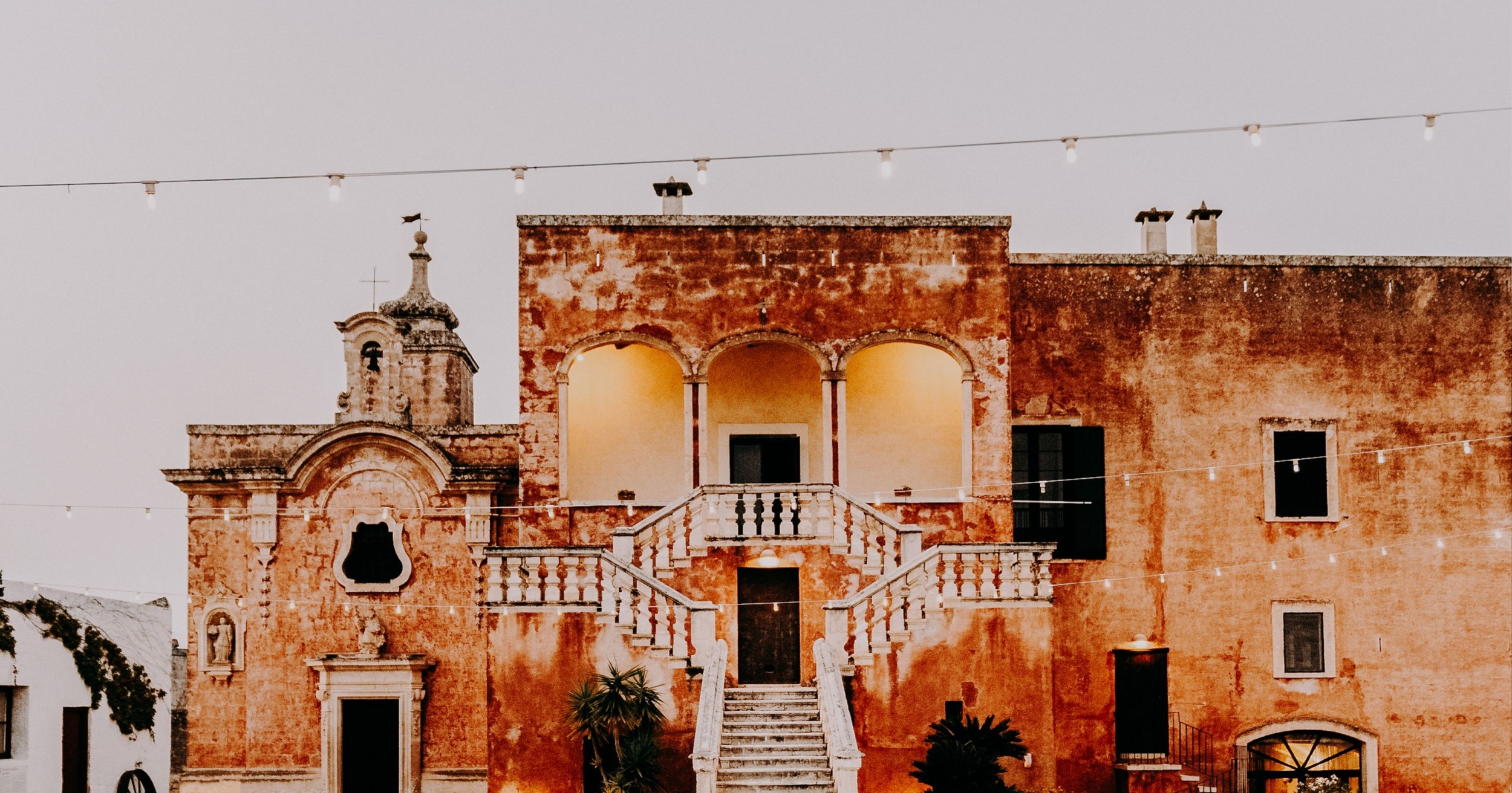
Couples planning a destination wedding in Puglia often search for something that no purpose-built venue can offer: a place where the history is structural, not decorative. Masseria Spina Resort, just outside Monopoli in the province of Bari, is one of the rare wedding venues in Italy that genuinely qualifies. Most masserie in Puglia date to the seventeenth century. Masseria Spina begins its story considerably earlier. The fortified complex visible today spans a period from the eleventh to the eighteenth century — and beneath the current structures, the evidence of even earlier settlement reaches back to the ninth century, when a community of some size carved its existence into the rock of this hillside, leaving behind rupestrian dwellings, ancient burial sites, and the foundations of an eleventh-century church. This is not a venue dressed in history. It is a venue that is made of it.
The family that welcomes you today — the Meo-Evoli — have dedicated themselves to maintaining this estate as a living place rather than a preserved monument. The distinctive dark red walls that make Masseria Spina instantly recognizable across the flat Puglian plain surround seven hectares of centuries-old olive grove, and within those walls the layering of centuries is legible everywhere: Baroque church façades, medieval tower structures, internal spaces that still carry the names of their original purposes. It is one of the oldest documented historic residences in Puglia, and that depth gives a wedding held here a quality that newer venues — however beautiful — simply cannot manufacture.
Six Residences, Each With Its Own Story
The accommodation at Masseria Spina is organized as six distinct historic residences rather than a conventional hotel. Each apartment is named, each has its own documented history, and each occupies a different part of the fortified complex with its own relationship to the surrounding landscape.
La Masseria is the principal apartment — positioned in the piano nobile of the central fortified body, the part of the estate built by the Chiantera family in the fifteenth century and later expanded by the Spinas in the sixteenth, with the monumental Baroque staircase added by the Martinellis in 1760. It offers sea views and accommodation for up to eight guests in antique-furnished rooms with original architectural details. Il Nido occupies the original fortified nucleus, also with sea views, and traces its structural origins to the same fifteenth-century construction phase. La Filanda — the old silk-processing building, constructed in the eighteenth century — recalls the period when Carlo III of Bourbon's investment in the San Leucio silk industry in Caserta sent ripples across the entire southern Italian economy. Il Fico takes its name from the ancient fig tree visible through its living room window. La Lamia is among the oldest inhabitable structures in the complex. Il Mezzanino was for years the home of the estate's coloni — the farming families who worked these lands.
Together, the six residences accommodate up to thirty-two guests on site across eleven double bedrooms and eleven bathrooms, with additional sleeping capacity in the living spaces. For international couples flying to Puglia specifically to get married in Italy, the combination of a coherent historical estate and genuine private accommodation creates an experience that a standard hotel block simply cannot replicate.
The Ceremony: Olive Grove, Sea Terrace, or Baroque Chapel
Masseria Spina offers three meaningfully distinct ceremony settings, and the differences between them are not cosmetic — each reflects a different relationship between the couple and the place they have chosen.
The centuries-old olive grove allows for a ceremony under living trees that may be older than the estate's recorded history. The quality of light that filters through ancient olive canopy — silver-grey, directional, constantly shifting — is unlike anything a garden or courtyard can produce. For couples who want their ceremony to feel rooted in something genuinely ancient rather than merely picturesque, the grove is the answer.
The sea terrace places the ceremony at the edge of the property's elevated position, with the Adriatic as the backdrop. The coastline between Monopoli and Polignano a Mare is one of the most visually dramatic in Puglia, and having it visible during the exchange of vows gives photographs a depth and context that indoor or enclosed settings cannot provide.
For those who want a religious setting, the estate's Baroque chapel — the Chiesa dell'Immacolata, its façade one of the Baroque elements added in the eighteenth century — provides a consecrated space with genuine artistic heritage. This is not a reconstructed chapel or a converted outbuilding. It is a functioning historic church that has been part of this estate for centuries.
Does the age of a venue actually change how a wedding feels?
There is a difference between visiting history and celebrating inside it. Masseria Spina sits firmly on one side of that line.
My work in this part of PugliaThe Indoor Spaces: Where the Estate's Working Past Lives On
The interior reception spaces at Masseria Spina carry the memory of their original functions in their names. The Sala Mangiatoie — the old feeding room, now serving as the estate's vineria — has the thick walls and vaulted structure of an agricultural interior that was built to be permanent. The Sala Fienile was the hayloft. The Sala Colonna is the formal restaurant space. None of these rooms were designed to host weddings. They were designed to last, and because of that they host them with a naturalness that specifically designed event spaces often lack.
The Corte — the central courtyard with the pool — serves as the hub of the estate's outdoor social life, and its configuration gives cocktail hours and aperitivo moments an architectural framing that enhances rather than simply contains the celebration. The Piazzale Principale, the main aia, can accommodate up to 400 people for concerts and large events, though for weddings the estate typically works with up to 180 guests — a scale that preserves the intimacy of the setting without feeling constrained.
The Arab Garden and the Rural Park: Two Landscapes That Set This Venue Apart
Two elements of Masseria Spina's outdoor landscape deserve specific mention because they are genuinely unusual among wedding venues in Puglia. The Orto Arabo — the Arab Garden — is a reminder that the cultural history of this part of southern Italy is not simply Norman or Baroque. The Arab presence in the agricultural and horticultural traditions of the region left marks that are still readable in the structure of certain gardens, and this one carries that history in its layout and planting logic. For couples drawn to the layered cultural identity of Puglia rather than its more marketed pastoral image, the Arab Garden is a detail that resonates.
Adjacent to the estate — and accessible to guests — is the Rural Park "Piana degli Ulivi," a protected olive grove that extends beyond the property's walls. Walking through it before or after a celebration, at the edge of light in the early morning or at the hour before sunset, gives guests a sense of the landscape that the masseria's walls, however beautiful, cannot entirely provide. As a wedding photographer working across the Bari province, I find that the transition between the enclosed estate and the open park creates photographic opportunities that are specific to this location and impossible to stage elsewhere.
Catering: An Unusual Degree of Flexibility
One practical detail about Masseria Spina that surprises many couples is the catering policy. Unlike most masserie of this scale, the estate permits both in-house catering and the use of an external caterer of the couple's choosing. This is genuinely uncommon at estates that handle weddings of up to 180 guests. For couples who have an existing relationship with a specific chef or catering team, or who have specific dietary or cultural requirements that they want handled by a specialist they already trust, this flexibility is a significant advantage. The in-house kitchen is fully capable and experienced in Puglian hospitality — the maitre Domenico, mentioned consistently in reviews from couples who have married here, is someone who understands how food and timing shape the emotional arc of a wedding day.
Getting to Masseria Spina: Why Monopoli Works So Well for a Destination Wedding
The estate's position — on the edge of Monopoli, within a short drive of Polignano a Mare — places wedding guests in one of the most visited and celebrated stretches of the Adriatic coastline. For international couples flying into Puglia to get married in Italy, the logistics here are among the most straightforward in the region. Bari Airport is approximately forty minutes away and receives direct flights from several European cities throughout the summer season; Brindisi is around fifty minutes. Monopoli's historic centre is a compact Baroque town with excellent restaurants and a working fishing port. Polignano a Mare, six kilometers away, is one of the most photographed towns in southern Italy: its old town built on the edge of a limestone cliff above the sea, its caves and coves visible from the water. Guests who arrive a few days before the wedding have immediate access to one of the most compelling coastlines in Italy — without any of the overcrowding that affects more heavily marketed destinations.
Does being near Polignano a Mare make it harder to focus on the wedding itself?
The best venues create their own gravity. Guests arrive early and leave late — not because they have to, but because they don't want to leave.
How I photograph destination weddings in this territoryMasseria Spina Resort: Straightforward Answers for Couples Planning a Wedding in Italy
We're coming from abroad — can we have a legally binding civil ceremony at Masseria Spina?
This is one of the most common questions international couples ask when planning to get married in Italy, and the answer depends on both your nationality and the estate's current municipal authorization. Italian civil ceremonies require advance documentation — typically filed through your home country's consulate or Italian embassy several months before the date — and not every venue is registered as an authorized location for legal acts. Some couples choose to complete the legal requirements at the local town hall and hold a symbolic ceremony at the estate, keeping the two separate for logistical simplicity. The Meo-Evoli team can advise on current options, and a locally based wedding coordinator with experience in destination weddings will be invaluable in navigating the paperwork specific to your nationality.
How old is Masseria Spina, really — and does that history affect the practical experience of the venue?
The documented history of the complex spans from the eleventh to the eighteenth century, with evidence of ninth-century settlement beneath the current structures. In practical terms, that age is visible in the quality of the walls, the scale of the interior spaces, and the layering of different architectural periods across the estate — each century leaving a legible mark. It also means that the building requires ongoing maintenance and care of a kind that modern venues do not, which the Meo-Evoli family has provided consistently. The experience of spending a day or several days within these walls is qualitatively different from a purpose-built event venue.
Can we use our own caterer, or are we required to use the estate's kitchen?
Both options are available, which is genuinely unusual for an estate of this capacity. You can choose the in-house catering team — which has extensive experience with Puglian cuisine and with the specific rhythms of a large wedding day — or you can bring in your own caterer. If you have a specific chef or catering company you want to work with, that flexibility is a real advantage. Confirm the specific logistics and requirements directly with the estate team when planning.
The estate sleeps 32 guests — how does that work for a wedding of 180 people?
The on-site residences are typically reserved for the bridal couple, immediate family, and the wedding party. The remaining guests stay in Monopoli (three kilometers) or Polignano a Mare (six kilometers), both of which have well-developed accommodation options at various price points. Many couples organize a shuttle service for the evening of the celebration, which removes the need for guests to drive after dinner and ensures that the party can continue on the estate without concern about departure timing.
What is the Arab Garden, and can it be used as a ceremony or reception space?
The Orto Arabo is a garden space within the estate that reflects the Arab-influenced agricultural and horticultural traditions of this part of southern Italy. It is one of the estate's distinctive outdoor areas and can be incorporated into the wedding day — as a cocktail hour setting, a photography location, or a quiet corner for guests during the reception. For couples with an interest in the layered cultural history of Puglia rather than its more conventional pastoral aesthetics, it is one of the details that makes this estate genuinely distinctive.
What is the Rural Park "Piana degli Ulivi," and is it part of the wedding experience?
The Rural Park is a protected olive grove adjacent to the estate, open to guests for walks and guided tours. It extends the visual and experiential range of a stay at Masseria Spina beyond the estate walls — giving wedding guests who arrive early or stay after the celebration access to an ancient agricultural landscape that puts the masseria in its larger territorial context. Guided gastronomic and historical tours of the estate and park can be organized for guests, and the estate also offers olive oil, wine, and liqueur tastings as add-on experiences.
Is the venue accessible for guests with disabilities?
The venue itself is fully accessible for guests with mobility requirements. The on-site residential accommodation is not adapted for wheelchair access, however — guests with specific mobility needs should plan to stay in Monopoli or Polignano where accessible accommodation options are available, and confirm the specific access routes within the estate for the ceremony and reception spaces during your initial site visit.