Inside the Walls: A Fortified Masseria Unlike Any Other Wedding Venue in Puglia
There are places that were built to endure. Masseria Ayroldi, a fortified masseria on the outskirts of Ostuni in the province of Brindisi, was built not to impress but to protect — and that original purpose has given it a character that no amount of design intervention could manufacture. Its thick defensive walls, its centuries-old chapel, its nearly three thousand olive trees spread across more than thirty-five hectares of land: this is a destination wedding venue in Puglia that carries the weight of a small, self-sufficient world within it, and that weight is present in every stone, every archway, every corner of shadow and light. For international couples planning to get married in Italy who are searching for something that goes beyond beautiful to something genuinely historic, Masseria Ayroldi is a category of its own.
As a wedding photographer working in and around Ostuni, I am drawn to venues that have accumulated something over time — a quality that cannot be installed or staged. Masseria Ayroldi has that quality in abundance. It was not built for weddings. It was built for survival, for community, for faith. The fact that it now hosts some of the most beautiful wedding celebrations in this part of Puglia feels not like a reinvention, but like a continuation of its original purpose: to be a place where people come together and feel held.
A Fortress Built to Last: The History of Masseria Ayroldi
The full name — Masseria Fortificata Ayroldi — speaks immediately to what distinguishes this property from every other masseria in the Ostuni area. The word fortificata is not decorative. This was a genuinely fortified agricultural complex, surrounded by walls built to protect harvests, animals, and the families who lived and worked within. The architectural styles that compose the building are varied and harmonious — the result, as the current owners describe it, of a construction process that unfolded over centuries, layer by layer, each generation adding its own contribution to a structure that had already been growing for longer than anyone could document with certainty.
The property takes its name from Giovanni Ayroldi, a documented owner who lived between 1696 and 1783. The first confirmed date of expansion is 1715, though the building itself is understood to be considerably older. Above the entrance, carved in stone, is a Latin inscription that has greeted every arrival for three centuries: Si Deus pro nobis, quis contra nos? — If God is with us, who shall be against us? Beside it, the initials MAG, standing for Magnificus Ayroldi Giovanni. This is not heritage as backdrop. It is heritage as identity, still present and still legible in the building's stones.
In 1769, the chapel dedicated to the Madonna del Rosario was built within the estate — a sacred space to serve the community of workers and families who lived within the walls, where Mass was celebrated without distinction of rank or status. Today, fully restored by the Pastore family who have taken this extraordinary property back to life, the chapel remains one of the most emotionally significant spaces on the estate and one of the most compelling ceremony settings I have had the privilege of photographing.
The Chapel of the Madonna del Rosario: A Ceremony Space of Extraordinary Power
A wedding ceremony in an 18th-century chapel that has served a living community continuously since 1769 is a different experience from a ceremony in any modern ceremony space, however beautiful. The stone here holds the memory of thousands of Masses, thousands of moments of faith and community. There is a quality of silence in old sacred buildings that is not the absence of sound but the presence of something layered, accumulated, and patient — and the chapel at Masseria Ayroldi has this quality in full. For couples who want a religious blessing, a symbolic rite, or simply the atmosphere of genuine sacred architecture to frame their vows, this chapel is one of the most remarkable options available at any wedding venue in the Ostuni area.
Photographically, the chapel presents one of those rare environments where every frame feels inevitable — the contrast between the rough ancient stone and the delicate details of a bridal look, the light filtering through small windows onto whitewashed walls, the depth of the interior drawing the eye inward toward the altar. I have photographed in chapels across Puglia, and few of them carry this combination of intimacy and historical weight in such a concentrated form.
The Olive Grove and the Land: 35 Hectares of Puglian Countryside
Beyond the walls, Masseria Ayroldi unfolds across more than thirty-five hectares of agricultural land, anchored by almost three thousand olive trees. Majestic holm oaks dot the surrounding territory, and it is the combination of these two presences — the ancient olive grove and the isolated, sovereign oaks — that gives the landscape around the masseria a quality of solemnity that the more domesticated gardens of other venues rarely achieve. This is not managed parkland. It is a living agricultural landscape that has been tended and shaped over centuries, and the light it produces at golden hour — warm, dense, filtered through thousands of silver-leafed branches — is among the most beautiful natural photographic light I have encountered anywhere in my work.
For outdoor ceremonies, the olive grove provides a setting of extraordinary depth and atmosphere. Long rows of ancient trunks, twisted and silver-barked, create a natural architecture that frames a ceremony without enclosing it — open to the sky, grounded in the earth, entirely of its place. The contrast between the fortified stone of the masseria and the organic generosity of the surrounding landscape creates a visual tension that makes every photograph taken here feel alive and full of meaning.
The Pool, the Rooms, and the Experience of Staying Within the Walls
The restoration of Masseria Ayroldi by the Pastore family has been conducted with the kind of fidelity to original materials and colours that distinguishes a genuine act of preservation from a surface renovation. The rooms — offered across three categories, Comfort, Deluxe, and Superior — sit within the historic fabric of the building, their proportions shaped by centuries of agricultural use, their materials drawn from the same Puglian limestone and plaster that defined the original construction. Staying here is not like staying in a contemporary hotel that happens to occupy a historic building. It is a genuinely immersive experience, in which the building itself becomes part of the celebration.
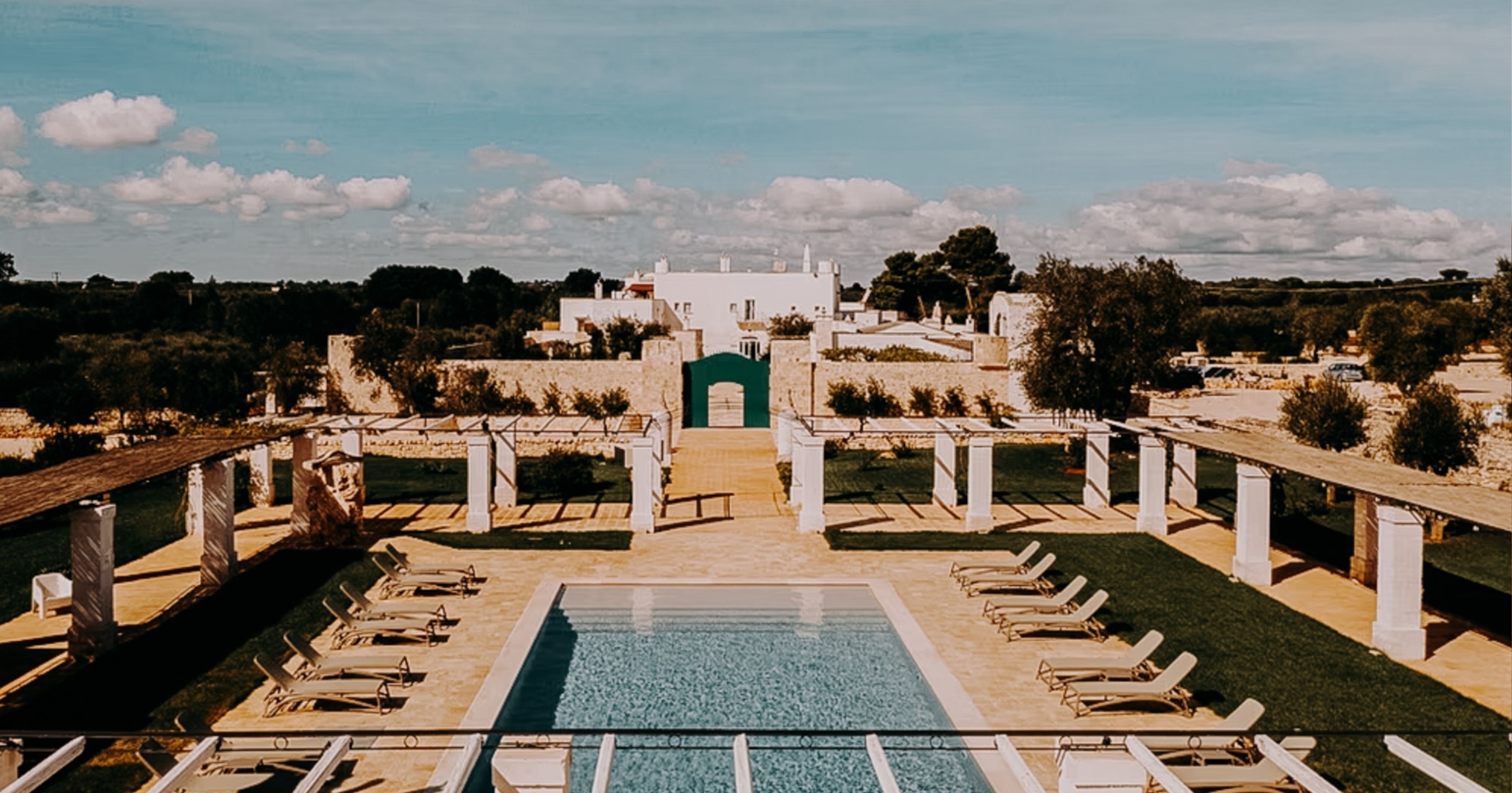
The pool occupies one of the most beautiful positions on the estate — a space where the views of the surrounding countryside open up and the relationship between the enclosed world of the masseria and the wider Puglian landscape becomes palpable. For a welcome party the evening before the wedding, a poolside aperitivo between the ceremony and dinner, or the slow morning after when guests drift out into the sunshine with their coffee and begin to absorb where they are, the pool area provides exactly the kind of unhurried, beautiful space that makes a multi-day destination wedding different from a single-day event.
Wellness experiences are available on site, including massage treatments, which makes the estate genuinely self-contained for couples who want their guests to have access to rest and relaxation without needing to leave the property.
Cuisine: The Kitchen at the Heart of the Masseria
The restaurant at Masseria Ayroldi serves food that is rooted in the territory — the olive oil from the estate's own groves, the vegetables of the Puglian countryside, the handmade pasta and the regional cheeses and cured meats that have defined cooking in this area for generations. Wedding menus are built around these materials, assembled as a journey through the flavours of the Ostuni countryside rather than as a performance of gastronomic technique. The kitchen's conviction here is that the land itself is the best chef — and in an estate where the olive trees have been producing fruit for centuries, that conviction is not modesty but accuracy.
Getting to Masseria Ayroldi: Practical Information for International Couples
Masseria Ayroldi is located at Strada Provinciale 29, Km 5.3, 72017 Ostuni (BR), in the province of Brindisi. Brindisi Airport is the most convenient option for the majority of international guests, at approximately 30–35 minutes by car. Bari Airport is around 75 minutes away and serves a wider range of international routes. The town of Ostuni — the White City, perched on its hill with views across the Adriatic plain — is just minutes from the property and provides a spectacular setting for a post-ceremony portrait session. The surrounding area includes Fasano, Cisternino, Alberobello, and the Adriatic coast, all within easy reach for guests who want to extend their stay and explore this part of Puglia at their own pace.
Photographing a Wedding at Masseria Ayroldi
What makes Masseria Ayroldi genuinely unusual as a photographic location is the combination of enclosure and openness that defines its character: the world within the walls — the chapel, the courtyard, the rooms, the inscriptions — and the world beyond them, where the olive grove and the countryside open up toward the horizon. A full wedding day here offers a visual arc that moves from the intimate and architectural to the vast and agricultural, from interior candlelight to exterior golden hour, from the Latin inscription above the entrance to the last stars appearing above the olive canopy. I work here the same way I work everywhere in Puglia: quietly, unhurried, trusting that in a place with this much accumulated story, the images will come without being forced. For couples who want to capture the atmosphere of the day in motion as well as in stills, the wedding film service adds the dimensions of sound and movement that photography alone cannot hold.
Can you really photograph a 300-year-old inscription, an ancient chapel, and an olive grove at golden hour — all in the same day?
At Masseria Ayroldi, yes. But only if you know where to be at each moment, and why. That knowledge is not instinct — it is the product of years spent learning how light moves through buildings and landscapes like this one.
Discover how Francesco worksMasseria Ayroldi: What Couples Ask About This Historic Fortified Wedding Venue in Puglia
We're an international couple planning to get married in Italy — how does the legal ceremony work at Masseria Ayroldi?
For foreign nationals, getting legally married in Italy requires documentation filed through the Italian consulate in your home country, typically several months before the wedding date — exact requirements vary by nationality and country of residence. Whether a civil ceremony can take place directly on the estate or whether the legal formalities are handled at the Comune di Ostuni is something to confirm with the masseria team. Many international couples choose to complete the legal paperwork at home or at the town hall and hold a symbolic ceremony or religious blessing at the venue itself — in which case the estate's 18th-century chapel is an exceptional setting. A locally based coordinator experienced in destination wedding legalities for foreign couples is strongly recommended.
What makes Masseria Ayroldi different from other masseriedestination wedding venues near Ostuni?
The key distinction is the word fortificata — fortified. Unlike the more typical Puglian masseria, Masseria Ayroldi was built with defensive walls, a fortified structure, and a self-contained community logic that has left a physical legacy of extraordinary historical depth. The Latin inscription above the entrance, the 1769 chapel dedicated to the Madonna del Rosario, the nearly three thousand olive trees surrounding the estate — all of this gives the property a character and a weight that most venues in the area simply do not have.
Can we hold a religious ceremony in the chapel at Masseria Ayroldi?
Yes. The chapel of the Madonna del Rosario, built in 1769, is available for religious ceremonies, blessings, and symbolic rites. For Catholic couples who want the full significance of a religious ceremony within the grounds of the venue itself — without the logistics of an external church — this is one of the most genuinely historic and emotionally charged options available at any wedding venue near Ostuni.
How large are the olive groves, and can the ceremony take place among the olive trees?
The estate extends across more than thirty-five hectares with almost three thousand olive trees. Outdoor ceremonies in the olive grove are possible and create a setting of extraordinary natural beauty — ancient, silver-barked trunks, filtered light, the scent of the Mediterranean countryside. The combination of the fortified masseria in the background and the ancient agricultural landscape in the foreground produces images that feel genuinely unlike anything available at more conventional venues.
What accommodation is available for wedding guests at Masseria Ayroldi?
The masseria offers rooms across three categories — Comfort, Deluxe, and Superior — all housed within the historic fabric of the restored building. The exact number of rooms and overall guest capacity is best confirmed directly with the estate team, as this determines the scale and format of celebration that works best for your guest list and the multi-day experience you want to create.
Is the property close to Ostuni and other attractions in the area?
Yes. The masseria is located just minutes from the historic centre of Ostuni — the White City, one of the most photographed towns in Puglia — and within easy reach of Fasano, Cisternino, Alberobello, and the Adriatic coastline. For international guests arriving for a multi-day wedding celebration, this geographic position makes the estate an ideal base for exploring one of the most beautiful and distinctive areas of southern Italy.