A Stone Inscription, Three Centuries of Celebrations: Masseria Papaperta, Wedding in the Valle d'Itria
Above the entrance to the main hall, a stone bears an inscription that has been there since the beginning: 1724. Nicolò Perta. The man who founded this estate — and whose name it still carries, compressed into the word Papaperta — left his mark in the building's fabric three centuries ago, and it has not been moved, restored, or reframed. It is simply there, as it always was, greeting everyone who arrives to celebrate something here. For international couples planning a destination wedding in Puglia who are searching for a venue whose authenticity is not a style choice but a biographical fact, Masseria Papaperta in the territory of Castellana Grotte — near Alberobello and the trulli of the Valle d'Itria — is the kind of place where that quality is visible from the first stone you touch. Getting married in Italy means something different when the building you are married in has been accumulating that specific meaning since 1724.
As a wedding photographer working across the province of Bari and the Valle d'Itria, I have always been drawn to places in this territory where the vernacular architecture — trulli, dry-stone walls, white limestone — has not been translated into something else but simply been inhabited and continued. Masseria Papaperta is one of the most complete expressions of that kind of continuity I have encountered anywhere in this part of Puglia.
The Ancient Oak and the Civil Ceremony
At the heart of Masseria Papaperta, rising from the green lawn that stretches between the trulli and the main building, stands a centuries-old oak tree that functions as the ceremonial centrepiece of the estate. This is where couples say yes. The Comune di Castellana Grotte has officially designated Masseria Papaperta as its casa comunale — which means that legal civil ceremonies can take place directly on the estate, under this oak tree, without any need to first visit a town hall. The couple is married here, in front of this specific tree, in this specific landscape, with the white silhouette of the trulli in the background and the Puglian countryside beyond them. For international couples who want a legally binding ceremony in Italy without splitting the wedding day between a municipal office and the venue, this designation is one of the most practical and emotionally significant advantages the estate offers.
Photographically, the oak tree produces images that have a quality impossible to manufacture: the way the afternoon light breaks through the canopy at different angles depending on the season, the scale of the tree relative to the people beneath it, the sense of something much older than the occasion itself presiding over it. I have never found a ceremony backdrop in the Valle d'Itria that carries quite this combination of scale, age, and natural drama.
Six Trulli in a Row, and the Landscape They Define
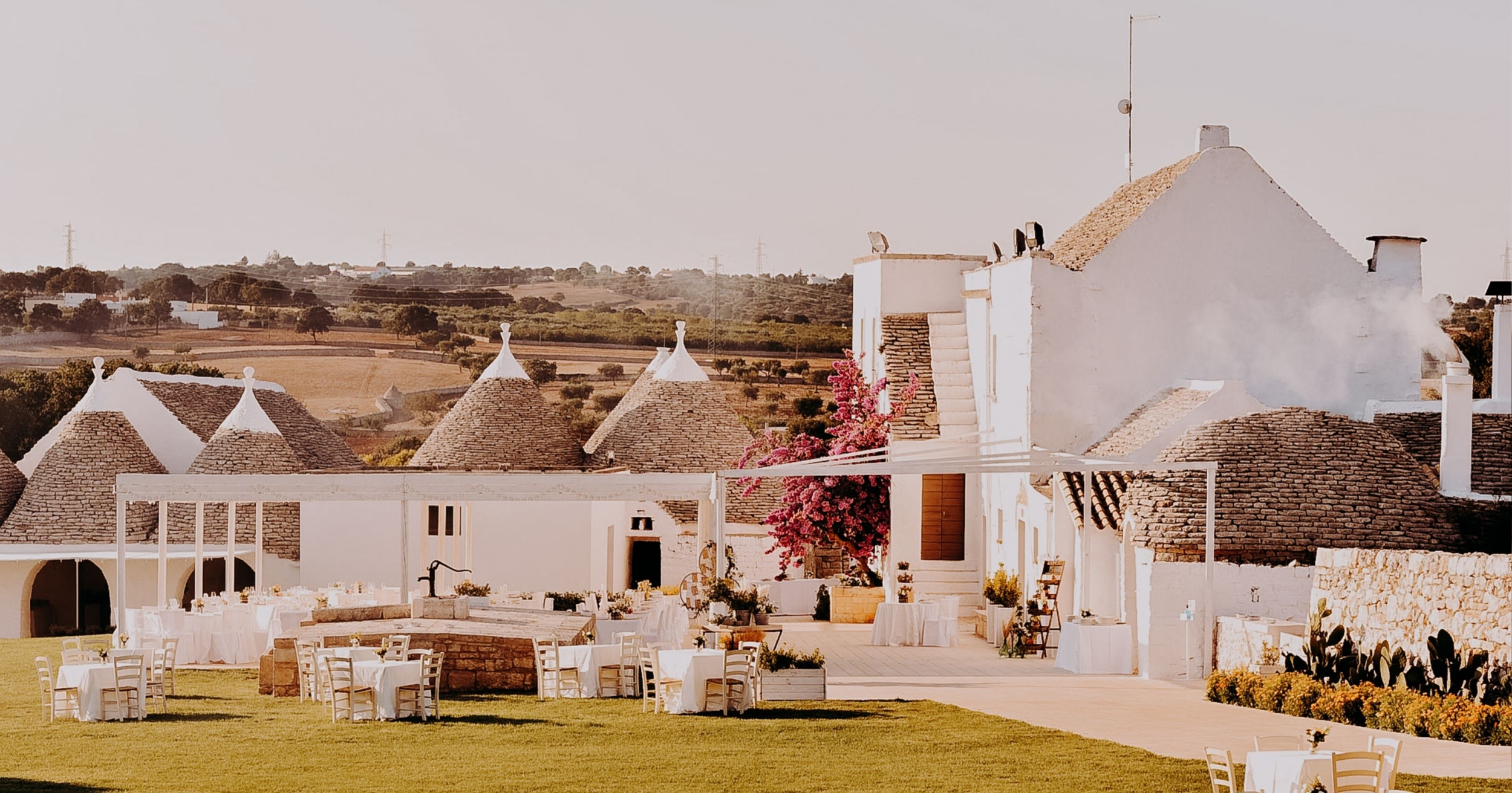
The silhouette of Masseria Papaperta is defined by its trulli — and particularly by six trulli in a row, a schiera, whose conical roofs trace the profile of the horizon in a sequence that is immediately and unmistakably of this territory. Trulli are the architectural signature of the Valle d'Itria: dry-stone conical structures built without mortar, whose construction tradition was inscribed on UNESCO's World Heritage list in 1996 as part of the Alberobello recognition. To be married in a landscape defined by this architecture is to be married in one of the most recognisable and genuinely irreproducible environments in all of Italy.
Beyond the six trulli in a row, two individual trulli give the estate additional layers of character. The trullo called Silos stands alone, set slightly apart from the main group, with an external staircase that was once used by farmers to store provisions for winter — and that today has become, according to the estate itself, the most photographed corner of the property. The trullo called Forno is one of the few remaining examples of a fully conical trullo — not the typical form with a flat base — and its interior walls still carry the soot of its original furnace function. These are not restored spaces dressed to look old. They are old spaces, used continuously, carrying the evidence of their own history on their walls.
The Ancient Stable, the Internal Hall, and the Lawn
The estate's spaces for celebration are varied and complementary. The ancient stable — entirely in stone, with the original eighteenth-century floor intact — is among the most atmospherically concentrated indoor spaces in the Valle d'Itria: the kind of room where centuries of ordinary agricultural use have left something in the walls that no amount of interior design could place there intentionally. For cocktail hours, intimate dinners, or any moment where a smaller enclosed space is needed, the stable provides a setting that feels genuinely of its period.
The internal hall at the heart of the masseria communicates with the gardens through large glass windows that bring the green of the external lawn and the white of the trulli directly into the dining environment. This is where receptions unfold in full — where the long tables are laid, where the music begins, where the evening expands into the kind of collective celebration that a Puglian wedding dinner, with its many courses and its unhurried rhythm, is built to produce. The kitchen is fully equipped and catering is managed in-house, with menus constructed around the traditional recipes of this territory and adapted for dietary requirements including allergies and intolerances.
Between the trulli and the masseria building, a stretch of well-kept green lawn provides the outdoor gathering space that connects all these elements. White linen, the white of the Puglian stone, the green of the grass: the colour palette of Masseria Papaperta in summer is one of the most visually simple and satisfying available at any wedding venue near Alberobello.
Does a three-hundred-year-old oak tree need a photographer who knows how to be quiet?
The ceremony under the ancient oak at Masseria Papaperta happens once. The light through the canopy, the shadow on the white stone, the specific way that moment looks — these are not recoverable. I have one job at a ceremony like this, and it is not to direct it.
How Francesco worksGetting to Masseria Papaperta: Practical Information for International Couples
Masseria Papaperta is located on the S.P. 161, Km 8.9, in the territory of Castellana Grotte, province of Bari. Bari Karol Wojtyła Airport is the most convenient international entry point, at approximately 60 kilometres. Brindisi Airport is also accessible and serves routes from many European hubs. Alberobello — the UNESCO-listed trulli town and the most famous destination in the Valle d'Itria — is a short drive from the estate. Castellana Grotte, known for its extraordinary cave system, is the nearest town. The Adriatic coast at Monopoli and Polignano a Mare is also reachable within a reasonable drive, making the estate a natural base for a multi-day destination wedding for guests who want to combine a celebration with a genuine experience of this part of southern Italy.
Photographing a Wedding at Masseria Papaperta
The challenge and pleasure of photographing at this estate is the density of material available at every scale. The inscription stone above the entrance. The soot on the walls of the trullo Forno. The external staircase of the trullo Silos and the view it gives of the surrounding landscape. The afternoon light through the ancient oak during the ceremony. The silhouette of the six trulli against the sky at dusk. The glass windows of the internal hall reflecting the green of the lawn. None of these images need to be constructed — they are already there, waiting to be seen at the right moment. I work at this kind of estate the same way I work everywhere in Puglia: with patience, with quiet attention, and with the conviction that the best images at a wedding are found rather than made. For couples who also want the sounds and movement of the day recorded in a cinematic form alongside the photography, the wedding film service adds the dimension of time — the pizzica dancing, the toasts under the oak, the cicadas in the afternoon silence — that still photography cannot capture alone.
Masseria Papaperta: Useful Answers for Couples Planning a Wedding in the Valle d'Itria
Can foreign couples have a legally recognised civil ceremony at Masseria Papaperta?
Yes. Masseria Papaperta holds the official status of casa comunale of the Comune di Castellana Grotte, which means that legal civil ceremonies can take place directly on the estate — under the ancient oak tree — without requiring a separate visit to the town hall. For foreign nationals, this does not remove the need to prepare documentation in advance through the Italian consulate in your country of residence; requirements vary by nationality and the process typically begins several months before the wedding date. A locally based wedding coordinator experienced with international couples is the most practical way to navigate this. But the ceremony itself can happen here, under this tree, legally and completely.
What exactly is a trullo, and why does it matter for a wedding in this area?
A trullo is a dry-stone conical structure built without mortar, using the flat limestone slabs characteristic of the Valle d'Itria. The construction technique dates back centuries and the trulli of Alberobello were inscribed on UNESCO's World Heritage list in 1996. Masseria Papaperta includes multiple trulli in different forms — six in a row defining the estate's visual horizon, a standalone trullo with an external staircase, and the remarkable trullo Forno, one of the few fully conical examples remaining in the area, whose soot-marked interior documents centuries of use as a furnace. For an international couple, being married in a landscape shaped by this architecture is one of the most specific and unrepeatable things a destination wedding in Italy can offer.
Is there a pizzica performance at weddings at Masseria Papaperta?
The estate mentions pizzica as part of the wedding experience — the traditional folk music and dance of Puglia, rooted in the Salento but present throughout the region's celebration culture. Whether a pizzica performance is included in a standard wedding package or arranged on request is something to confirm directly with the estate team. For international couples unfamiliar with it, pizzica is one of the most genuinely local and joyful things a Puglian wedding can offer: fast, rhythmic, communal, and impossible to watch without eventually being pulled in.
Does Masseria Papaperta have accommodation on site for wedding guests?
The estate's website does not mention on-site guest accommodation. The territory of Castellana Grotte and the wider Valle d'Itria offer a range of accommodation options nearby, including other masseriae, agriturismo properties, and hotels in Alberobello and surrounding towns. The estate team can advise on the best options for your guest group.
How is catering managed at Masseria Papaperta?
Catering is managed in-house, with a fully equipped kitchen on site. Menus are built around traditional Puglian recipes reinterpreted in a contemporary key, and the estate explicitly caters for dietary requirements including intolerances and allergies. This in-house management means that the food served at your wedding is a direct expression of the estate's own standards rather than a variable introduced by an external caterer.
Is Masseria Papaperta close enough to Alberobello for guests to visit on the wedding weekend?
Yes. The estate is located in the heart of the Valle d'Itria, with Alberobello a short drive away. For international guests who have never visited this part of Puglia, the combination of the UNESCO-listed trulli of Alberobello, the cave system at Castellana Grotte, the Adriatic coast at Monopoli and Polignano a Mare, and the white hill towns of the Valle d'Itria makes this one of the most rewarding areas in southern Italy for a multi-day destination wedding stay.