A Sixteenth-Century Fortified Village Near Ostuni: Getting Married at Masseria Montalbano
Most masseriae were farms. Masseria Montalbano was a village. The distinction is not merely architectural — it changes entirely what a wedding here means. The Borgo di Montalbano Vecchio, set on the S.S. 16 between Fasano and Ostuni in the province of Brindisi, is a sixteenth-century fortified settlement surrounded by its original walls, with a church, stables, an olive press, and the long rows of farmworkers' dwellings that once housed a community of more than three hundred people. Today, those dwellings have been converted into twenty rooms and suites. The olive press has become the Sala Frantoio, one of the most architecturally distinctive reception spaces in the Ostuni area. The church of the Beata Vergine del Rosario still stands in the central courtyard, its main altar still bearing the coat of arms of the noble family that rebuilt it. For international couples planning a destination wedding in Puglia who want a venue that is not simply old but genuinely, documentably historic — a place with a social and political history that is readable in the stones — Masseria Montalbano is an entirely different category of estate from anything else available near Ostuni.
As a wedding photographer based in and around Ostuni, I have photographed celebrations at estates across this part of Puglia. What strikes me most at Masseria Montalbano, coming back to it over time, is how little it needs to be anything other than what it already is. A sixteenth-century fortified village in twenty hectares of centuries-old olive groves does not require decoration to make an impression. It requires attention — the kind of attention that notices the quality of light on ancient stone, that finds the right moment in the courtyard at the hour when the church façade catches the last sun.
A Village in Its Own Right: The History of Montalbano Vecchio
The estate dates from the sixteenth century, during the period of Spanish dominion over this part of southern Italy. It reached the height of its importance in the seventeenth century when it passed into the possession of the Acquaviva d'Aragona, Counts of Conversano — one of the most powerful noble families in the Kingdom of Naples. Under Giangirolamo II Acquaviva d'Aragona, and subsequently under his successor Giulio II, the estate was substantially developed. To Giulio II is attributed the reconstruction of the church dedicated to the Beata Vergine del Rosario, whose main altar still carries the Acquaviva coat of arms. At the height of its activity as a working village, Montalbano Vecchio counted more than three hundred inhabitants living within its walls — an entirely self-sufficient agricultural community with its own places of worship, its own production infrastructure, its own internal social order.
The recent restoration has been conducted with a conservationist logic: recovering original spaces and materials, restoring the ancient chianche stone flooring — thick local limestone slabs laid directly on the ground — and reorienting the whole estate around hospitality without erasing the physical evidence of what it was. The result is a property where five thousand square metres of covered historic space give any wedding a physical scale and a material depth that simply cannot be reproduced in a purpose-built venue.
The Sala Frantoio: Up to 300 Guests Inside the Olive Press
The heart of the indoor reception offering at Masseria Montalbano is the Sala Frantoio — the converted olive press that forms one of the most recognisable interior spaces in the Ostuni wedding circuit. The sala is characterised by warm tones of wood and stone, by the proportions and structural logic of a working agricultural building that was built to contain large volumes and heavy equipment, and by the accumulated atmosphere of a space that spent centuries at the productive centre of this community. It seats up to 300 guests. Adjacent rooms and smaller salette within the masseria complex provide additional interior space for different moments of the day — cocktails, music, quieter gatherings. The sheer covered area of the estate — five thousand square metres — means that the indoor experience of a wedding here has a spatial generosity that very few venues in this part of Puglia can match.
The Courtyard, the Church, and the Ancient Olive Grove
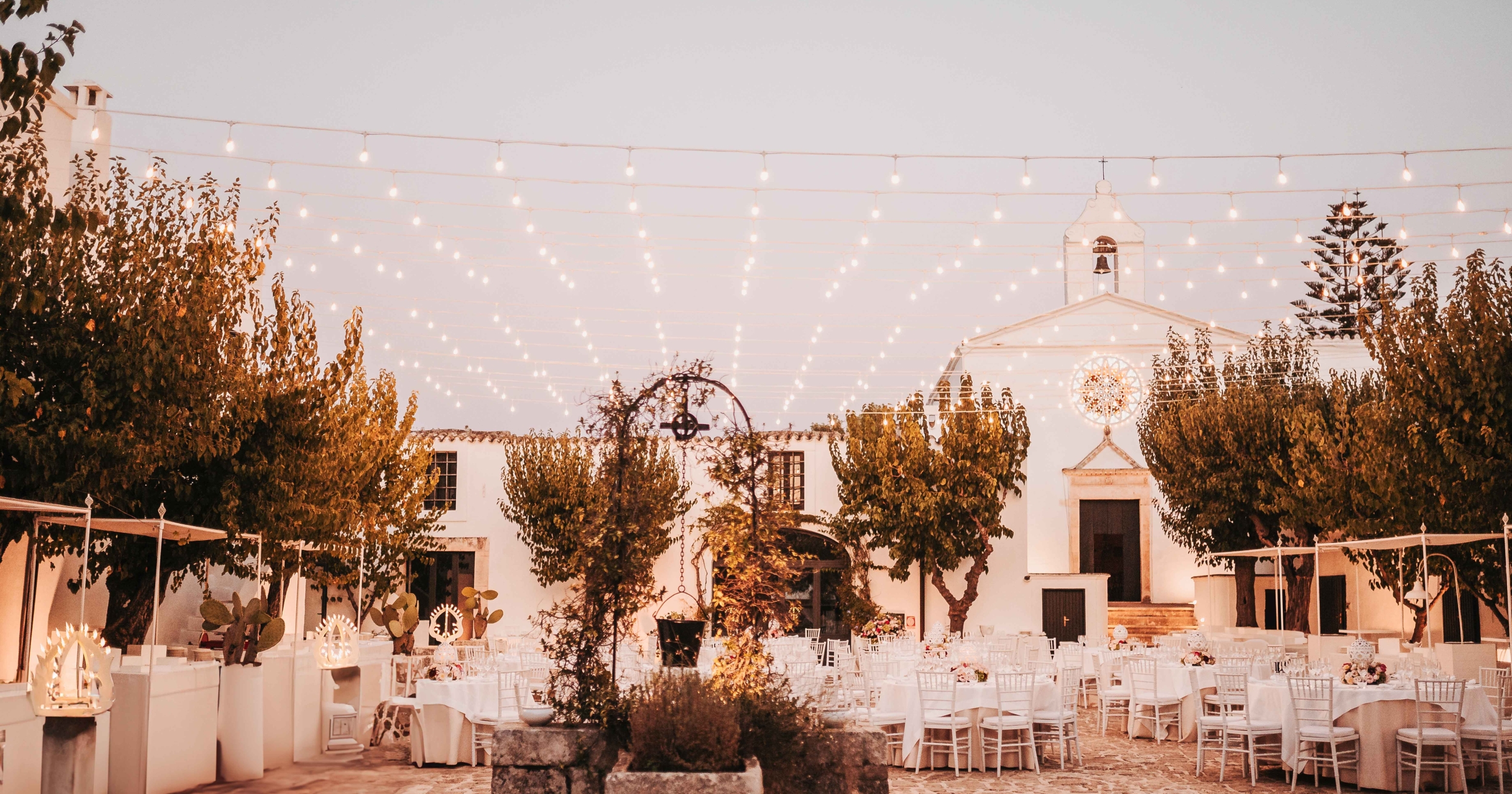
The central courtyard of the masseria is the spatial and emotional centre of the estate. It is where the church of the Beata Vergine del Rosario stands — its façade white in the Puglian manner, its interior bearing the noble history of the Acquaviva patronage in the coat of arms above the altar. The courtyard accommodates up to 400 guests for outdoor celebrations: long tables under the open sky, the ancient stone walls on every side, the sounds of the Puglian countryside at night arriving from beyond the walls of what was once a village that contained its own world. For outdoor ceremonies, for the transition between cocktail hour and dinner, for the dancing that goes on long past midnight in the Puglian tradition, the courtyard is a space of extraordinary physical authority.
Beyond the walls, the estate is set within twenty hectares of centuries-old olive groves. The combination of the enclosed village world inside the walls and the open agricultural landscape outside them gives the property a visual arc across the day — from the intimacy of the courtyard and the stone interiors to the open, luminous world of the olive grove — that is one of the defining photographic qualities of the estate.
Twenty Rooms Designed by Jos Van Dyck
The farmworkers' dwellings that once lined the internal avenues of Montalbano Vecchio — low structures built in rows, each consisting of a bedroom and a kitchen with a fireplace — have been converted into the estate's twenty rooms and four suites. The interiors were designed by Belgian designer Jos Van Dyck: warm tones, carved furniture, embroidered fabrics, an atmosphere that balances the vernacular directness of the original architecture with a considered contemporary elegance. The avenue leading to the rooms, shaded by tall palms and coloured throughout the season by bougainvillea, is one of the most immediately beautiful passages on any estate in this part of Puglia — and one of the most photographed. Having all wedding guests accommodated within the original farmworkers' dwellings of a sixteenth-century village is not a detail. It is the substance of what makes a multi-day wedding here unlike anything available elsewhere near Ostuni.
Is a 16th-century fortified village too much backdrop — or exactly enough?
Some venues disappear behind the wedding. At Masseria Montalbano the estate is a participant. How that presence is photographed — when to let it dominate, when to step aside and let the people fill the frame — is a judgment that has to be made differently here than anywhere else.
How Francesco worksIn-House Catering with Celiac Certification
The kitchen at Masseria Montalbano manages catering in-house and holds certification from the Associazione Italiana Celiaci — a practical detail that matters significantly for international wedding parties whose dietary requirements span a wider range of needs than a smaller, more informal caterer can reliably accommodate. The cuisine is built on the regional tradition of Puglian cooking: locally sourced ingredients, the recipes of this agricultural territory, a quality of execution that reflects the estate's long standing in the top tier of the Ostuni wedding market. The estate's own staff describe their kitchen as designed specifically to meet the demands of large weddings, with particular attention to dietary specifics.
Getting to Masseria Montalbano: Practical Information for International Couples
Masseria Montalbano is located on the S.S. 16, km 871.8, in the territory of Ostuni, province of Brindisi. Brindisi Airport is the closest international entry point, at approximately 35 kilometres. Bari Airport is around 75 kilometres to the north and serves a wider range of international routes. The white hill town of Ostuni — one of the most famous and photographed destinations in Puglia — is a short drive from the estate. The Adriatic coast and the beaches of the Savelletri and Torre Canne area are also accessible within a reasonable distance, giving international guests arriving for a multi-day celebration a range of excursion options across one of the most scenically varied stretches of the Puglian coastline.
Photographing a Wedding at Masseria Montalbano
The visual material at this estate is stratified in the way that a place with four centuries of continuous human occupation tends to be: surfaces that have been touched and worn by use, spaces whose proportions were determined by functions that no longer exist, light that falls at angles shaped by walls built without any consideration of how a photographer might want to use them. I find this kind of environment the most demanding and the most rewarding to work in. The palm-lined avenue to the rooms at the hour when the afternoon light goes horizontal. The courtyard in the brief window between sunset and the lighting of the lamps. The interior of the Sala Frantoio where the warm tones of wood and stone hold candlelight in a way that almost nothing else does. For couples who want to add the dimension of moving image to the photographic record, the wedding film service captures the sounds and movement of this estate — the cicadas in the olive grove, the music in the courtyard, the atmosphere of a historic village at night — that still images alone cannot fully render.
Masseria Montalbano: Questions From Couples Planning a Destination Wedding Near Ostuni
How does the legal wedding process work for foreign couples getting married at Masseria Montalbano?
Foreign nationals wishing to marry legally in Italy need to begin the process several months in advance through the Italian consulate in their home country, with requirements varying by nationality. Whether a civil ceremony can take place directly on the estate — rather than at the Comune di Ostuni — is something to confirm with the masseria team. Many international couples separate the legal formalities from the celebration itself: completing the civil registration at the town hall and holding the ceremony and reception at the masseria on the wedding day. A locally based wedding coordinator with experience in destination weddings for international couples is the most reliable guide through this process.
What makes Masseria Montalbano a masseria-villaggio rather than a conventional masseria?
A conventional masseria was primarily an agricultural production complex — a farm with associated outbuildings. A masseria-villaggio was a self-sufficient settlement: a complete community with its own church, its own production facilities, and residential accommodation for all the people who lived and worked within its walls. Masseria Montalbano at its seventeenth-century peak housed more than three hundred inhabitants. The physical remains of that community — the rows of farmworkers' dwellings, now converted into twenty rooms, the church of the Beata Vergine del Rosario, the olive press, the stables, the fortified walls — are all still present and readable. This is the quality that distinguishes the estate architecturally from any other venue in the Ostuni area.
Does the estate host more than one wedding per day?
No. Masseria Montalbano hosts a single wedding per day, which means that the entire estate, its staff, and its organisational attention are dedicated exclusively to one celebration at a time. For international couples managing the logistics of a destination wedding from abroad, this exclusive-use policy is one of the most important practical guarantees the estate offers.
Is there a wet-weather plan at Masseria Montalbano?
Yes. The estate's five thousand square metres of covered historic space — including the Sala Frantoio and the various internal rooms and salette — means that a full indoor reception is available as an alternative to outdoor celebrations without any reduction in scale or atmosphere. The estate itself notes that the indoor option is sometimes chosen as the primary plan, not merely as a contingency, given the quality of the interior spaces.
Who designed the rooms and suites at the masseria?
The twenty rooms and four suites — housed within the original farmworkers' dwellings along the estate's internal avenues — were designed by Belgian designer Jos Van Dyck. The interiors work with carved furniture, embroidered textiles, and warm tones that respect the vernacular character of the original architecture while providing a contemporary level of comfort and elegance.