Getting Married Inside a Working 1846 Olive Press: Masseria Capece as a Destination Wedding Venue in the Valle d'Itria
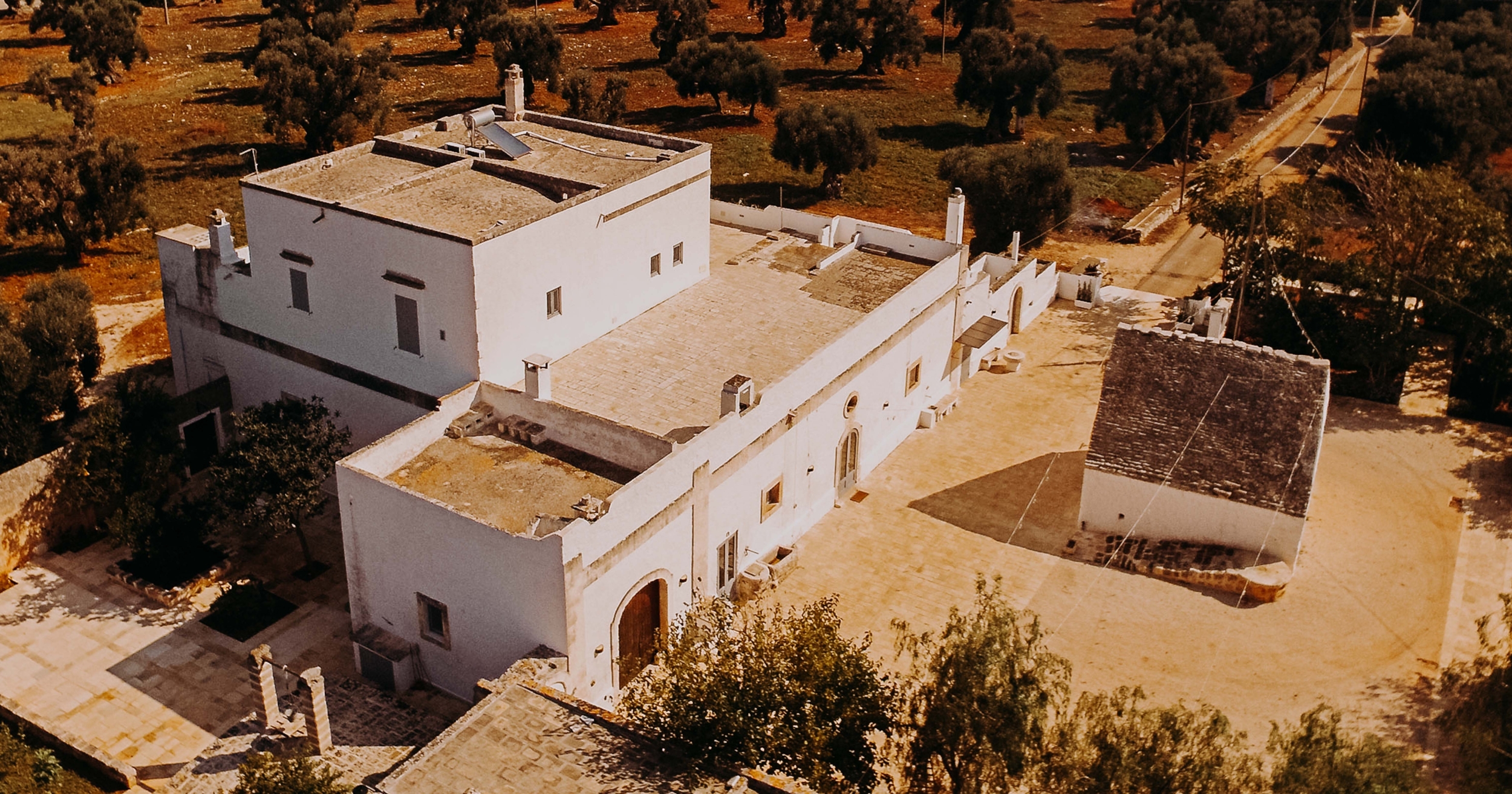
The manufacturer's label is still legible on the original press. The stone millstones — once turned by horse traction — are still in position. The wooden mammarelle presses, the cast-iron presses, the steel hydraulic pump: all present, all intact, all exactly where they have been since this frantoio was built in 1846 and began pressing the oil of two thousand-year-old olive trees in the Puglian countryside between Cisternino and Fasano. When couples choose to hold their wedding reception inside this space, they are not sitting in a room that has been styled to evoke the agricultural past. They are sitting inside that past — breathing it, touching it, surrounded by it on every side. For international couples planning a destination wedding in Puglia and searching for a venue that offers something genuinely impossible to manufacture, Masseria Capece presents a proposition that no amount of design intervention could replicate: a working farmhouse estate where the event spaces are the history, not a frame around it.
As a wedding photographer based in the province of Brindisi, I am drawn to places where the visual narrative has been written by time rather than by a stylist. Masseria Capece is extreme in this regard — in the best possible sense. There is almost nowhere to put the camera here that does not produce an image saturated with layer and character. The aged stone walls, the vaulted ceilings, the machinery that spent a century pressing oil, the citrus grove where fruit is still harvested for the breakfast table every morning: these are not props. They are the everyday reality of an estate that has been alive and productive since the 1700s and that is still alive today.
The Frantoio: A 19th-Century Olive Mill as Wedding Reception Hall
There are many converted barn receptions. There are many dining rooms with exposed stone and vaulted ceilings. There is, to my knowledge, almost nowhere else in Puglia where you can seat between one hundred and twenty and one hundred and forty guests inside an olive press whose original machinery — wooden presses, cast-iron presses, a stone basin with three millstones — is still fully intact and still occupying the room alongside them. The frantoio at Masseria Capece was built in 1846 and operated until the 1960s. It pressed oil from the trees that surround this estate, trees whose planting is said to date back more than two thousand years to the veterans of the Punic Wars. The space has a quality that is hard to describe but immediately felt: the accumulated weight of ordinary daily work, of pressing and fermenting and storing, of something essential being made here for over a hundred years. A wedding reception here does not take place in front of this history. It takes place inside it. A dedicated catering kitchen is located adjacent to the mill, which means that the logistical requirements of a seated dinner for a large wedding party are well supported within the space.
Two Thousand Years Old: The Millenary Olive Grove and the Threshing Floor
The olive grove that surrounds Masseria Capece extends across approximately thirty-five hectares of the territory between Cisternino and Fasano. The trees within it are classified as millenary — ancient specimens of Ogliarola Salentina and Leccina whose root systems go deeper than most buildings stand tall, whose trunks carry the distortions and expansions of centuries of growth, whose planting tradition holds that they were established by veterans returning from the Punic Wars more than two thousand years ago. Whether that attribution is legend or documented history matters less than what these trees look like at four in the afternoon in July, when the light falls horizontally through silver foliage and the ground between the trunks is warm and fragrant and perfectly still. For outdoor ceremonies, for portrait sessions at golden hour, for the slow circulation of guests between cocktails and dinner, the olive grove offers a setting of extraordinary natural age and depth.
Slightly apart from the main complex of the masseria, in a panoramic position that commands views across the surrounding landscape toward the sea, stands the ancient stone threshing floor — the aia — where grain was once separated from chaff at the centre of agricultural life here. Today this elevated, open space is used for events and for the Festival dei Sensi, one of the most evocative outdoor events in the Valle d'Itria. The combination of the agricultural plain stretching below and the Adriatic glinting in the distance makes the threshing floor one of the most visually compelling outdoor event spaces in this part of Puglia.
The Citrus Grove: A Walled Garden of Forty Varieties
The walled citrus garden at Masseria Capece measures fifty by fifty metres and contains — by the estate's own count — more than forty varieties of fruit: lemon, orange, vanilla orange, mandarin, grapefruit, citron, bergamot, Spanish lime, apricot, persimmon, quince, loquat, mulberry, fig, pomegranate, and others. At the centre, a shaded pathway under a grapevine pergola runs the length of the garden. Rainwater is collected in a large cistern built for the purpose. The fruit from this garden is harvested daily for the breakfast table — squeezed, sliced, made into jams — and the same ingredients, grown metres from the kitchen, inform the estate's cooking throughout the season. For cocktail hours and intimate gatherings, this walled garden is a setting that combines the enclosure and scent of a private kitchen garden with the visual generosity of a botanical collection that has been accumulating for centuries.
Twelve Apartments: Accommodation Within the Masseria Itself
Masseria Capece is an agriturismo, which means that staying here is not an arrangement made with a third-party hotel down the road — it is an integral part of the experience of the estate. The twelve apartments sit within the historic fabric of the masseria, all featuring the stone star and barrel vault ceilings that are the architectural signature of the building. The restoration, carried out by the De Carolis-Romito family who have brought this extraordinary property back to life, sought to balance the specific qualities of the original materials and proportions with the requirements of contemporary hospitality: the result is spaces that feel genuinely of their period without feeling compromised by it. Corte Fiorita, Corte dei Massari, Corte Aurora, Suite Padronale Fico d'India, Suite Arancio: each distinct, each housed in a different part of the original masseria complex, and each offering the particular quality that only on-site accommodation at a genuinely historic estate can provide — the ability to walk out in the evening into an olive grove that has been standing for two millennia, and to walk back in for breakfast harvested from a citrus garden that has been producing fruit since before anyone now alive was born.
The estate is affiliated with the Regional Natural Park of Coastal Dunes, an ecological designation that speaks to both the environmental significance of the property and the quality of the landscape that surrounds it. Pets are welcome.
Is a wedding inside a nineteenth-century olive press too unusual — or not unusual enough?
The frantoio at Masseria Capece seats up to 140 guests inside machinery that has not been removed, not been replicated, not been softened. Some couples see that immediately as their place. Others need a photograph to understand it. I have that photograph.
How Francesco worksRestaurant Giano and the Estate's Kitchen
The restaurant at Masseria Capece — Ristorante Giano — occupies the ancient stable that formed part of the original nucleus of the masseria, its two indoor dining rooms sitting under vaulted ceilings that date to the same period as the rest of the building. Outside, a shaded terrace under a grapevine pergola extends the dining area into the courtyard. The cooking is rooted in the Apulian tradition with contemporary interpretations by the estate's chef: the citrus from the garden, the oil from the olive grove, the seasonal produce of a territory that has been farmed here without interruption for centuries. For wedding celebrations, the proximity of the catering kitchen to the frantoio makes the olive press the natural reception venue — the food arriving from a kitchen that draws on the same agricultural intelligence that has sustained this estate since the 1700s.
Getting to Masseria Capece: Practical Information for Couples Travelling from Abroad
Masseria Capece is located at Contrada Capece 1, 72014 Cisternino (BR), in the Valle d'Itria, on the road between Cisternino and Fasano. Brindisi Airport is approximately 47 kilometres away — around 45 minutes by car. Bari Airport is also accessible in roughly an hour. The estate offers a paid shuttle service for guests arriving by train at the nearest stations of Fasano and Cisternino. For multi-day celebrations, the location is exceptional: Alberobello and its trulli are 15 kilometres away, the white hill town of Cisternino is minutes from the property, Monopoli and the Adriatic coast are 20 kilometres to the east. The estate is fully accessible for guests with reduced mobility and offers ample on-site parking. The surrounding landscape — designated as part of the Regional Natural Park of Coastal Dunes — means that nature excursions, cycling through the olive groves, and trekking in the area are genuine daily options for guests staying over multiple days.
Photographing Masseria Capece
The challenge at Masseria Capece is not finding something worth photographing — it is choosing. The frantoio alone produces images in every light condition that would be difficult to achieve in most purpose-built venues; the darkness of the vaulted interior, the geometry of the original machinery, the contrast between the roughness of the stone and the delicacy of wedding dress and candlelight. The citrus grove at midday gives a different quality entirely: shaded, scented, enclosed, intimate. The ancient olive grove in the late afternoon is the kind of environment where I work very slowly and very quietly, because there is nothing to add to what is already there. And the threshing floor at dusk, with the view to the sea opening up below and the sky going orange above the Murge ridgeline, is among the most complete natural outdoor frames I have worked within anywhere in Puglia. For couples who want both a photographic record and a moving image of the day, the wedding film service captures the ambient sounds of this estate — the grinding of stone, the wind in the olive canopy, the cicadas at dusk — that a still image cannot hold.
Masseria Capece: Honest Answers for Couples Planning a Wedding in Italy
How does the legal wedding process work for foreign couples getting married in Italy at Masseria Capece?
Foreign nationals wishing to marry legally in Italy need to begin the documentation process several months in advance through the Italian consulate in their country of residence — the exact timeline and paperwork required vary by nationality. Whether a civil ceremony can take place directly on the estate or requires a visit to the Comune di Cisternino is something to confirm with the masseria team and with your local coordinator. Many international couples opt to complete the legal formalities at the town hall and hold the ceremony itself — symbolic or religious blessing — on the estate, which allows the full expressive potential of the property to shape the wedding day without administrative constraints.
What is it actually like to hold a reception inside the olive press?
The frantoio seats between 120 and 140 guests. The original machinery — wooden presses, cast-iron presses, stone millstones, the basin where horses once turned the grinding wheel — remains in the room, not as museum display but as architectural presence. The vaulted stone ceiling is high, the space has an industrial grandeur softened by centuries of use, and the adjacent catering kitchen means that service during a seated dinner functions without difficulty. For couples drawn to the idea of an event space shaped by genuine working history rather than decorative heritage, there is nowhere quite like it in the Valle d'Itria.
Are the millenary olive trees really two thousand years old?
The tradition that the olive grove at Masseria Capece was planted by veterans of the Punic Wars is a local attribution that cannot be documented with the precision of a stone date, unlike the 1739 and 1846 dates carved into the masseria's architecture. What is undisputed is that the trees are classified as millenary — ancient specimens of Ogliarola Salentina and Leccina of extraordinary age — and that the grove has remained in its original planting layout without modification or densification since the estate's earliest records. Whether two thousand years is precise or approximate, what these trees look like in golden hour light is entirely, verifiably, real.
Can guests eat from the citrus grove and taste the estate's olive oil?
Yes. This is one of the genuine pleasures of an agriturismo celebration at Masseria Capece. The citrus grove produces more than forty varieties of fruit, harvested daily for the breakfast table — as fresh fruit, as freshly squeezed juice, as homemade jams. The estate's extra virgin olive oil, produced from the millenary grove's Ogliarola and Leccina trees, is woven into the cooking. The connection between what grows on the property and what arrives on the table is not a marketing claim here but an everyday operational reality.
Is an agriturismo the right setting for an elegant wedding, or does it feel too rustic?
The restoration of Masseria Capece was designed explicitly to balance agricultural authenticity with contemporary elegance — the star and barrel vault ceilings of the apartments, the refined details of the interiors, the restaurant's sophisticated reinterpretation of Puglian cuisine. The estate is an agriturismo in the original sense: a working farm with roots in centuries of agricultural life, but one whose hospitality is carefully considered and whose spaces have been brought to a level of quiet refinement. Rustic in the sense of genuine — not in the sense of rough.
What is there to do in the area for wedding guests staying for several days?
The position of Masseria Capece is exceptional for multi-day groups. Alberobello and its UNESCO-listed trulli are 15 kilometres away. The white hill town of Cisternino — one of the most beautiful borghi in southern Italy — is minutes from the estate. The Adriatic coast and Monopoli are 20 kilometres to the east. The Valle d'Itria more broadly offers cycling routes through the olive groves, the caves of Castellana, the Baroque architecture of Martina Franca, and the vineyards of the Itria Valley. For guests who have never been to this part of Puglia, a three or four-day stay centred on the masseria and its surrounding territory is one of the most concentrated experiences of southern Italian landscape, food, and culture available anywhere in the region.