Underneath the Olive Grove: The Hypogean Olive Press That Makes Masseria Alchimia Unlike Any Other Wedding Venue Near Savelletri
Most wedding venues end the evening on a terrace or a dancefloor. Masseria Alchimia ends it underground. Beneath the olive grove, carved from the living rock of the Puglian countryside, the estate's ancient hypogean olive press — a grotto — functions as the after-party venue for weddings celebrated here, with no time limit, no noise curfew, no ceiling except the stone one that has been in place for centuries. This is not a wine cellar dressed up for dancing. It is a genuine underground space, the production heart of the estate in another era, and the experience of moving the party down into it as the night deepens is one that guests at Masseria Alchimia describe as genuinely unlike anything they have encountered at any other destination wedding in Puglia. For international couples planning to get married in Italy who want a celebration that moves through different registers across the day — from ceremony in a lama canyon to dinner under the stars on the piazza to dancing in a cave that once pressed oil — this nineteenth-century estate at Contrada Fascianello in Savelletri di Fasano is a venue in a category of its own.
I photograph weddings regularly in and around Savelletri as a wedding photographer working across the province of Brindisi, and Masseria Alchimia occupies a position in this landscape that is immediately and consistently unusual. The three hectares of olive groves that surround it are nothing exceptional for this stretch of coast. What is exceptional is what lies within the groves and beneath them: the lama — the ancient Puglian canyon carved by a river that once ran from here to the sea, now dry but fully preserved — and the hypogean press below the surface. These are features that no renovation could add after the fact. They are what the land is.
Three Locations in One: The Five Spaces of a Masseria Alchimia Wedding
The estate frames its wedding offer explicitly as three locations in one, and the five distinct spaces it identifies make that claim credible in a way that most venues cannot. The shaded garden between the olive trees is the first: an intimate, enclosed environment for the civil ceremony, a symbolic rite, or the aperitivo welcome. The piazza — the estate's aia, the ancient threshing floor — is the centre of gravity for the evening: where the dinner tables are laid, where a stage can be built, where dancing begins under an open Puglian sky. The panoramic terrace is where the cake-cutting and toasts take place, with the view over the surrounding olive grove. The lama canyon in the olive grove — a dry Puglian river bed, a natural geological feature that runs between the ancient trees — provides a ceremony setting of extraordinary natural drama, with the option of an elegant tensile structure with wooden flooring and dimmable lights as a covered alternative within the same space. And then the grotto: the hypogean frantoio, underground, for the after-party with no time constraints.
This sequence — from the intimacy of the garden ceremony, through the convivial openness of the piazza dinner, to the descent into the stone cave for the hours when the night really begins — gives a wedding at Masseria Alchimia a narrative arc that is genuinely theatrical in the best sense: each space different in character, each transition intentional, the whole experience composed rather than merely assembled.
The Nineteenth-Century Building and Its Contemporary Interior
Masseria Alchimia was built in the nineteenth century. Its exterior — whitewashed stone, the proportions and silhouette of the traditional Puglian agricultural building — is entirely of its period and its territory. Its interior is something else entirely. The rooms and suites have been furnished with contemporary art, pieces of modern and iconic design, and a palette of white and light that is deliberately minimal and deliberately international in its references. The estate's own description is exact: the interior is conceived as an antithesis to the conventional agriturismo aesthetic, offering something that belongs to the vocabulary of design hotel rather than of rural accommodation, while the building's historic fabric — the stone walls, the vaulted ceilings, the proportions inherited from its agricultural origins — remains fully legible. The seven rooms and suites (four doubles and three suites) accommodate up to twenty guests on site, each with its own private entrance, kitchenette, and outdoor space. Exclusive use for weddings includes two nights of accommodation across all seven rooms.
The Lama: A Puglian Canyon in the Olive Grove
The lama is a geographical feature specific to the karst landscape of Puglia: a dry canyon carved over millennia by a watercourse that once ran from the inland plateau to the sea. The lama at Masseria Alchimia runs through the olive grove, a natural corridor of exposed limestone and ancient trees that creates a ceremony environment with a quality of drama entirely unlike the flat, open spaces of the conventional olive grove setting. The contrast between the rough geological character of the canyon walls and the cultivated order of the surrounding olive trees is one of those landscape combinations that is specifically, irreducibly of this territory. For a ceremony in the lama — whether civil, symbolic, or religious blessing — the space provides a natural enclosure and a depth of visual field that most outdoor ceremony settings cannot match. The tensile structure available as a weather alternative within the same space means that the lama setting does not depend on a clear sky to function.
Multicultural Weddings: Indian, Jewish, and Celebrations From Around the World
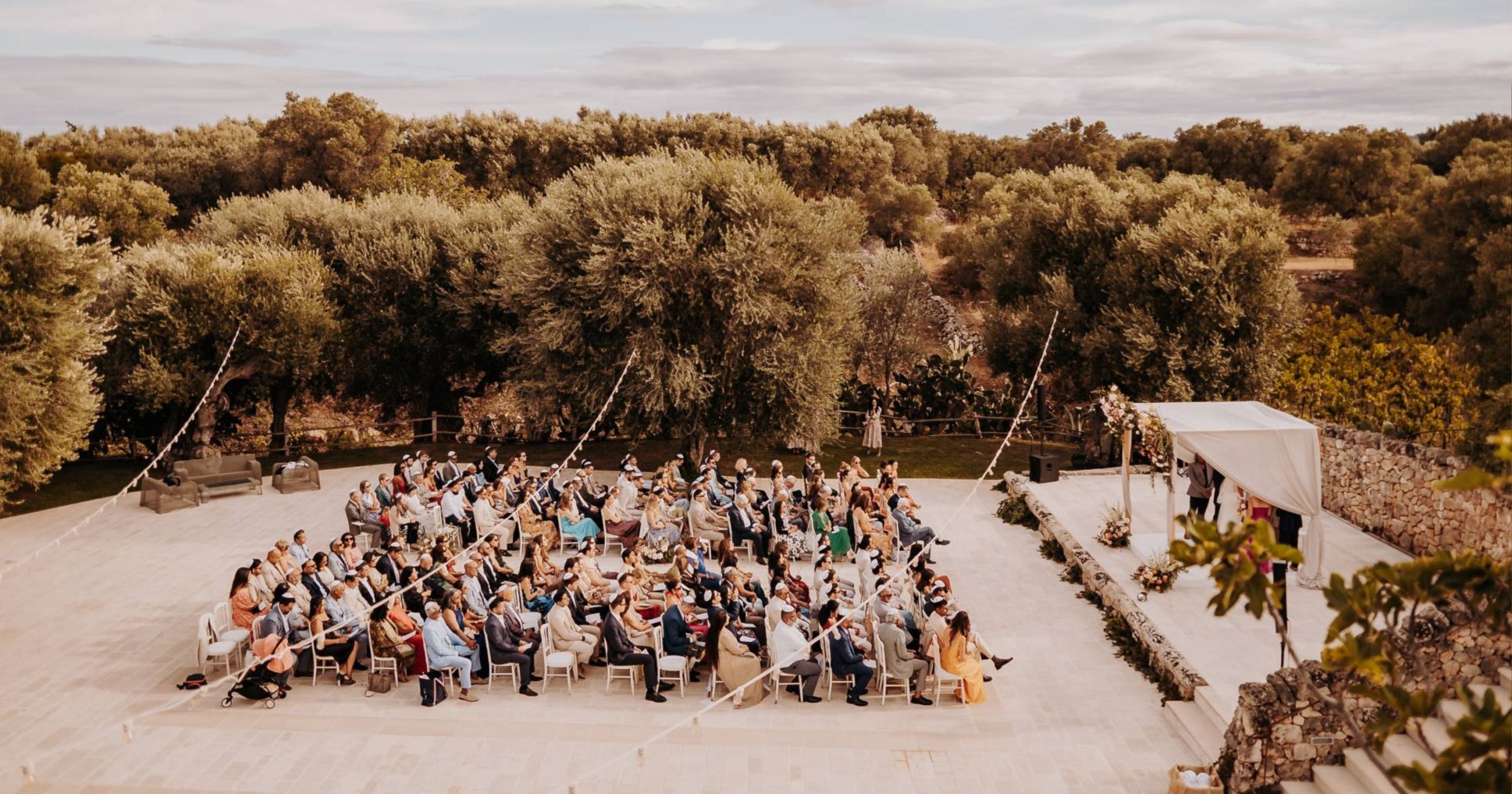
Masseria Alchimia hosts weddings from across the world and is explicit about its experience with multicultural celebrations. Indian weddings — with the Baraat procession, the Anand Karaj ceremony, traditional dance, and authentic Indian cuisine integrated into the Mediterranean landscape of the estate — are a documented part of the venue's celebration history. Jewish weddings, with the Chuppah set in the piazza or the olive grove, have found in this space the combination of natural and architectural grandeur that the ceremony's symbolism deserves. The estate's five distinct spaces, its capacity for multi-day celebrations, and its position at Savelletri — a short drive from Brindisi Airport, easily accessible from international hubs — make it a practical as well as beautiful base for couples and guests arriving from anywhere in the world.
When did you last dance until sunrise in a cave that used to press olive oil?
The grotto at Masseria Alchimia has no closing time. It is underground, it is stone, and it has been here for centuries. What happens inside it on a wedding night is entirely your own invention.
How Francesco worksGetting to Masseria Alchimia: Practical Information for International Couples
Masseria Alchimia is located at Contrada Fascianello 50, 72015 Savelletri di Fasano, province of Brindisi. GPS coordinates: 40.862698, 17.3588556. The sea at Savelletri is three kilometres from the estate. Brindisi Airport is the closest international gateway. Bari Airport, approximately 70 kilometres to the north, serves a wider range of international routes. The town of Fasano is two kilometres away. The coast between Savelletri and Torre Canne, the masseria landscape of the Fasano interior, Ostuni 25 kilometres to the south, and the Valle d'Itria are all within easy reach for guests who want to explore the territory across a multi-day wedding stay.
Masseria Alchimia: Questions From Couples Considering This Estate for Their Destination Wedding
Can we hold a legally binding civil ceremony at Masseria Alchimia?
Yes. The estate holds the official status of casa comunale, which means legal civil ceremonies can take place directly on the property — in the garden between the olive trees, in the lama canyon, or in another space of your choosing. For foreign nationals, the documentation process begins several months before the wedding through the Italian consulate in your country of residence, with requirements varying by nationality. A locally based wedding coordinator experienced with international couples is strongly recommended to manage the administrative process.
What exactly is the hypogean grotto, and how does it work as an after-party venue?
The grotto is the estate's ancient olive press, located underground — a hypogean space cut from the rock beneath the property. As an after-party venue it operates without a time limit: because it is underground, noise is contained within the stone, and the celebration can continue as long as the guests want. The space has the character of a genuine ancient agricultural space rather than a decorated cellar, and the experience of moving the party underground as the night deepens is one of the most specific and memorable elements of a wedding at Masseria Alchimia.
What is included in the wedding package?
The wedding package includes exclusive use of the estate for the ceremony and reception, two nights of accommodation across all seven rooms (four doubles and three suites, up to twenty guests), the hypogean grotto for the after-party without time limits, and a 300-square-metre tensile structure with wooden floor and dimmable lights as the wet-weather plan. The estate also provides access to a list of recommended local suppliers to assist with planning. Catering and other services are arranged through external providers.
Does Masseria Alchimia have experience with multi-day and multicultural weddings?
Yes. The estate explicitly offers multi-day celebrations and has hosted Indian weddings — including Baraat processions, Anand Karaj ceremonies, and traditional dance and food — as well as Jewish weddings with the Chuppah set within the estate's spaces. The combination of the property's five distinct environments, its on-site accommodation for up to twenty guests, and its position near Savelletri makes it a practical base for celebrations that unfold across several days and draw guests from multiple countries and cultural traditions.
What is the lama, and why is it used as a ceremony setting?
A lama is a dry canyon carved by an ancient watercourse — a geological feature specific to the karst landscape of Puglia. The lama at Masseria Alchimia runs through the olive grove and creates a natural corridor of exposed limestone and old trees that functions as a ceremony environment of considerable natural drama. A ceremony in the lama takes place within the geology of the land itself, in a space that no designer could replicate and no renovation could add. A tensile structure is available within the lama as a covered alternative in case of rain.